

Eosinophilic granulomatosis with polyangiitis is a rare disease whose standard treatment includes systemic glucocorticoids, bronchodilators, and immunosuppressive agents. Mepolizumab and benralizumab have recently emerged as therapeutic alternatives. The aim of this study was to evaluate the effectiveness and treatment outcomes in real-world practice.
MethodsThis retrospective observational study included 29 adult patients with eosinophilic granulomatosis with polyangiitis treated with mepolizumab and/or benralizumab at Hospital Universitario La Paz since 2017. Data were collected on oral glucocorticoid use, asthma therapies, immunosuppressive agents, eosinophil counts, and quality-of-life questionnaires to assess changes from baseline.
ResultsThe mean initial dose of prednisone was 15.4 mg per day. At six months, 60.9% of evaluable patients had reduced their dose, and at one year, glucocorticoids had been completely discontinued in 11 of 23 evaluable patients. Five patients continued on immunosuppressive therapy, while the rest discontinued it. Eosinophil counts decreased significantly at one year. Quality-of-life measures showed numerical improvements after one year of treatment.
ConclusionIn this real-world cohort, treatment with mepolizumab or benralizumab was associated with reduced glucocorticoid use and eosinophil counts. Some patients continued to require concomitant immunosuppressive therapy, particularly those with more complex disease presentations.
La granulomatosis eosinofílica con poliangeítis es una enfermedad rara cuyo tratamiento estándar incluye glucocorticoides sistémicos, broncodilatadores e inmunosupresores. Mepolizumab y benralizumab han surgido recientemente como alternativas terapéuticas. El objetivo de este estudio es analizar la efectividad y la evolución de los tratamientos en la práctica clínica real.
MétodosEstudio observacional retrospectivo que incluyó 29 pacientes adultos con granulomatosis eosinofílica con poliangeítis tratados con mepolizumab y/o benralizumab desde 2017 en el Hospital Universitario La Paz. Se recopilaron datos sobre glucocorticoides orales, terapias para el asma, inmunosupresores, recuentos de eosinófilos y cuestionarios de calidad de vida, evaluando cambios respecto al inicio.
ResultadosLa dosis media inicial de prednisona fue de 15,4 mg al día. A los seis meses, el 60,9% redujo su dosis, y al año, los glucocorticoides se suspendieron por completo en 11 de los 23 pacientes evaluables. Cinco pacientes continuaron con terapias inmunosupresoras, mientras que el resto las suspendieron. Los eosinófilos disminuyeron significativamente al año. Las medidas de calidad de vida mostraron una mejoría numérica tras un año de tratamiento.
ConclusiónEn nuestra cohorte, mepolizumab o benralizumab se asoció con una reducción del uso de glucocorticoides y del recuento de eosinófilos. Algunos pacientes con presentaciones complejas de la enfermedad continuaron con inmunosupresor concomitante.
Eosinophilic granulomatosis with polyangiitis (EGPA) is a rare disease that affects 2–3 people per million and is characterized by asthma, blood and tissue eosinophilia, and small to medium vessel vasculitis that involves various organs such as the skin, heart, lungs, or kidneys.1,2
The therapeutic approach is determined by the severity of the clinical presentation and the specific organs involved. In the initial phase, inhaled therapies for respiratory symptoms and systemic glucocorticoids constitute the foundation of treatment.3 The main concern is that prolonged use of glucocorticoids may lead to adverse effects, including osteoporosis, diabetes mellitus, hypertension, cataracts, adrenal insufficiency, or infections.4 In patients with vital organ involvement or an inadequate response to therapy, immunosuppressive agents such as cyclophosphamide, azathioprine, methotrexate, or rituximab are used in combination.4
A new therapeutic option has recently emerged: mepolizumab and benralizumab, both monoclonal antibodies targeting interleukin-5 (IL-5/IL-5Rα), which plays a key role in the proliferation, maturation, and differentiation of eosinophils.5 These medications have been shown in clinical trials to reduce disease relapses and decrease glucocorticoid use in patients.6,7 Mepolizumab is approved at a dose of 100 mg every 4 weeks for the treatment of severe eosinophilic asthma, and 300 mg every 4 weeks for hypereosinophilic syndrome.5 In contrast, benralizumab is approved at a dose of 30 mg every 4 weeks as maintenance therapy for severe eosinophilic asthma.
This study aims to investigate the effectiveness of monoclonal antibodies in the treatment of EGPA, as well as to evaluate the evolution of oral glucocorticoid use and other asthma treatments.
MethodsThis retrospective observational study included all patients diagnosed with EGPA who were treated with mepolizumab and/or benralizumab since January 2017 at Hospital Universitario La Paz in Madrid. Treatment was administered subcutaneously, and the doses of mepolizumab and benralizumab were 300 mg and 30 mg every four weeks, respectively. The sample included patients aged ≥18 years. This study was approved by the Hospital's Research Ethics Committee: code 2025.746, approval date: October 20, 2025. Given the retrospective nature of the study, informed consent was waived. Patient confidentiality and anonymity were ensured throughout the study.
Data were collected by reviewing their electronic medical records. We recorded the year of disease diagnosis, oral glucocorticoid (OCG) treatment, the use of medications for asthma management, immunosuppressive agents, and other monoclonal antibodies, as well as various scales such as the Asthma Quality of Life Questionnaire (AQLQ) and the Sino-Nasal Outcome Test-22 (SNOT-22), used to assess patient progression, relapses, and worsening of asthma signs and symptoms.
Glucocorticoid use was assessed using two approaches. First, the average daily dose of OGCs, expressed as prednisone equivalents, was assessed over three time periods: prior to the initiation of monoclonal antibody therapy, at six months, and at one year. Second, the percentage reduction from the baseline was calculated. Glucocorticoids administered via inhalation, topical, or intra-articular routes were not considered.
Data are presented as mean ± standard deviation (SD) or median (interquartile range [IQR]) for continuous variables, and as frequencies (n) and percentages (%) for categorical variables. Normality was assessed using the Shapiro–Wilk test. Comparisons were performed using Student's t-test or the Wilcoxon test, as appropriate. Patients with missing data were excluded from the corresponding analyses. Statistical significance was defined as p < 0.05.
ResultsIn total, 29 patients were analyzed, of whom 17 were women. The ages ranged from 22 to 79 years, with a mean age of 59.6 years. The median duration of treatment with monoclonal antibodies was 25 months (IQR: 32). However, six subjects initiated it less than one year ago; therefore, the available data were incomplete in these cases. The initial treatment was mepolizumab in 28 patients; however, three subsequently switched to benralizumab (two due to poor asthma control and one due to an adverse reaction). One patient received benralizumab as the sole biologic therapy.
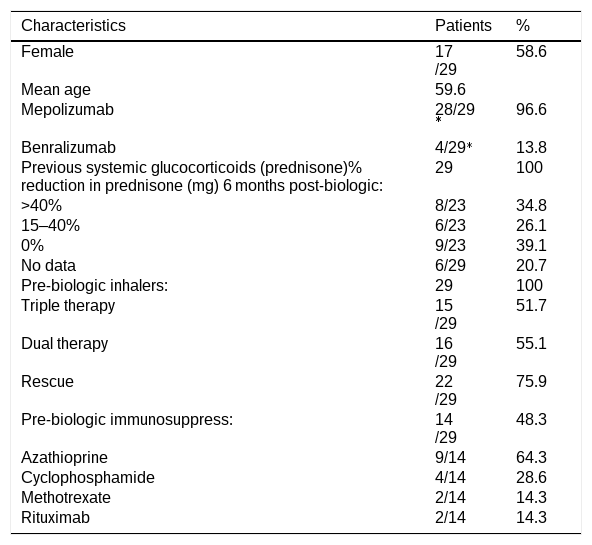
Table 1 summarizes the demographic and baseline treatment characteristics of the study cohort. Regarding glucocorticoid use, 100% of patients were on OCGs at baseline, with a mean prednisone dose of 15.4 mg per day. At 6 months, 17 of 23 evaluable patients (73.9%) continued using OCGs, while at 12 months, 12 of 23 evaluable patients (52.17%) continued using OCGs. At 6 months, 60.9% of the patients experienced some dose reduction: 8/23 (34.8%) achieved a reduction greater than 40%, 6/23 (26.1%) had a reduction of 15–40%, and 9/23 (39.1%) showed no dose reduction. Oral glucocorticoids were completely withdrawn in 11/23 patients (47.8%) one year after treatment initiation. This goal was achieved in all 4 patients who started with a daily dose of 2.5 mg, in 5/9 patients (55.6%) treated with 5 mg, and in 2/10 patients (20%) receiving doses equal to or greater than 10 mg.
Demographic characteristics, baseline treatment, and glucocorticoid dose reduction at 6 months in patients with EGPA.
| Characteristics | Patients | % |
|---|---|---|
| Female | 17/29 | 58.6 |
| Mean age | 59.6 | |
| Mepolizumab | 28/29⁎ | 96.6 |
| Benralizumab | 4/29⁎ | 13.8 |
| Previous systemic glucocorticoids (prednisone)% reduction in prednisone (mg) 6 months post-biologic: | 29 | 100 |
| >40% | 8/23 | 34.8 |
| 15–40% | 6/23 | 26.1 |
| 0% | 9/23 | 39.1 |
| No data | 6/29 | 20.7 |
| Pre-biologic inhalers: | 29 | 100 |
| Triple therapy | 15/29 | 51.7 |
| Dual therapy | 16/29 | 55.1 |
| Rescue | 22/29 | 75.9 |
| Pre-biologic immunosuppress: | 14/29 | 48.3 |
| Azathioprine | 9/14 | 64.3 |
| Cyclophosphamide | 4/14 | 28.6 |
| Methotrexate | 2/14 | 14.3 |
| Rituximab | 2/14 | 14.3 |
In relation to inhaled therapy, all patients were using it before starting monoclonal antibody therapy. Short-acting β-adrenergic agonists (SABAs) were the most commonly used rescue therapy (68.9%), followed by dual therapy (55.1%), triple therapy (51.7%), short-acting muscarinic antagonists (SAMAs) (17.4%), and long-acting muscarinic antagonists (LAMAs) (13%). Additionally, five patients (17.2%) were previously treated with other biologic drugs before mepolizumab or benralizumab, including omalizumab, reslizumab, and dupilumab.
In combination with monoclonal antibodies, 14/29 patients (48.27%) received other immunosuppressants: azathioprine (64.28%), cyclophosphamide (28.57%), rituximab (14.28%), and methotrexate (14.28%). In four cases, the patients used more than one immunosuppressant. At the end of the study, 5/14 patients (35.7%) were still receiving immunosuppressants, while the remainder had discontinued their use.
Baseline eosinophil counts in patients treated with mepolizumab showed a markedly skewed distribution. The mean was 2990 cells/μL (SD: 7080), while the median was 800 cells/μL (IQR: 1210), indicating the presence of extremely elevated values in a subset of patients. Missing data were recorded for two patients. One year after treatment initiation, the mean eosinophil count was 78.2 cells/μL (SD: 57.6), and the median was 70 cells/μL (IQR: 70) (Wilcoxon signed-rank test; n = 21; p = 0.0118). Six patients had missing data at this time point, and patients who switched to benralizumab were excluded from this analysis.
The following results were obtained from the quality-of-life questionnaires.
For the AQLQ, data were available for 13 patients at baseline, 6 months, and 12 months. The baseline mean (SD) score was 5.8 (0.9), increasing to 6.0 (0.9) at 6 months (p = 0.4059) and to a median of 6.4 (IQR: 1.1) at 12 months (p = 0.500), with no statistically significant differences from baseline. The high proportion of missing data limited the interpretation of these results.
For the SNOT-22, data were available for 17 patients at baseline, 6 months, and 12 months. Baseline data showed a mean score of 38.3 points (SD: 25.6) and a median of 31.0 (IQR: 42.5). One year after treatment initiation, the mean score was 31.0 points (SD: 23.2), and the median decreased to 26.5 (IQR: 33.8). These findings showed a numerical improvement in nasal symptoms and rhinosinusitis-related quality of life, although this difference did not reach statistical significance (p = 0.57).
DiscussionEGPA is an uncommon and heterogeneous disease that complicates the standardization of treatments. Our study provides data on the effectiveness of using anti-IL-5/IL-5Rα biologics in a cohort of patients treated at our hospital.
A relevant finding was the progressive reduction in the use of OCGs. At six months, nearly 61% of patients experienced some degree of dose reduction. In addition, complete discontinuation was achieved in patients who started with low doses. This finding confirms the steroid-sparing effect reported in clinical trials. This is clinically significant, given that prolonged glucocorticoid use is associated with multiple adverse effects.
Although anti-IL-5/IL-5Rα antibodies allow for a reduction in the glucocorticoid burden, some patients in our cohort received concomitant immunosuppressive therapy, particularly those with more complex disease presentations, with azathioprine and cyclophosphamide being the most commonly used.
The eosinophil count showed a marked reduction after one year of treatment, reflecting the effectiveness of monoclonal antibodies in controlling eosinophilic inflammation, although the initial variability and extremely high values in some patients highlighted the heterogeneity of the studied population.
The AQLQ and SNOT-22 scores showed a trend toward improvement, although the high proportion of missing data limited the strength of these conclusions. The results suggest a benefit in asthma control, nasal symptoms, and disease-related quality of life, but further data collection is needed to obtain reliable results.
The limitations of our study include the small sample size, due to the rarity of the disease, the retrospective single-center design, the absence of a comparator group, potential confounding by indication, missing data, and the short study period. Nevertheless, these findings provide real-world evidence on the use of anti–IL-5 therapies in EGPA, complementing data from clinical trials. The small sample size precludes drawing definitive conclusions regarding potential differences between mepolizumab and benralizumab.
In conclusion, patients who initiated treatment with mepolizumab or benralizumab at our institution presented a highly complex profile with a long history of poorly controlled disease and a substantial burden of prior treatments. In this real-world cohort, treatment was associated with reduced glucocorticoid use. Some patients continued to receive concomitant immunosuppressive therapy, highlighting the importance of individualized management.
Contribution to the literatureEosinophilic granulomatosis with polyangiitis is a rare disease in which chronic use of systemic glucocorticoids is associated with high morbidity due to serious adverse effects. This study provides relevant evidence from real-world clinical practice on the effectiveness of anti–interleukin-5 monoclonal antibodies, mepolizumab and benralizumab. More than half of the evaluable patients reduced their prednisone dose after one year of treatment, achieving complete withdrawal in eleven of them. In addition, a marked reduction in eosinophil levels was observed. Health-related quality-of-life measures showed numerical improvements, although these findings were limited by the small number of evaluable patients and missing data.
For the hospital pharmacist, these findings reinforce the importance of integrating targeted biologic therapies to optimize the treatment of EGPA. The corticosteroid-sparing effect of these drugs allows for a reduction in cumulative therapeutic burden and helps prevent long-term systemic complications. This work highlights the need for individualized pharmacotherapeutic follow-up, as patients with high disease activity often require combined immunosuppressive therapy. The results suggest that the implementation of these therapies in the hospital setting is key to improving symptom control and patient clinical stability.
Sources of supportPharmacy dispensing records, electronic medical records.
Responsibility and copyright transferAll authors accept the responsibilities defined by the International Committee of Medical Journal Editors (ICMJE; http://www.icmje.org/). The authors confirm that the study complies with applicable ethical standards. Ethical approval has been obtained in accordance with institutional and national regulations.
The authors hereby transfer exclusively, in the event of publication, the rights of reproduction, distribution, translation, and public communication (through any audio, audiovisual, or electronic medium or format) of our work to Farmacia Hospitalaria and, by extension, to the SEFH. To this end, a copyright transfer letter will be signed at the time of manuscript submission through the online manuscript management system.
Artificial intelligenceMedical writing and English-language editing support, including refinement of scientific style, were provided in part by an artificial intelligence-based tool (ChatGPT 5.1) and were subsequently reviewed and approved by the authors.
It has not been presented at any conference.
It is not under review by any other journal.
CRediT authorship contribution statementElena Benito Arribas: Writing – review & editing, Writing – original draft, Methodology, Formal analysis, Data curation, Conceptualization. Elena Villamañán Bueno: Writing – review & editing, Writing – original draft, Supervision, Project administration, Methodology, Investigation, Formal analysis, Data curation, Conceptualization. Daniel Laorden Escudero: Methodology, Formal analysis, Data curation, Conceptualization. Carlos Carpio Segura: Formal analysis, Data curation. Ana Noblejas Mozo: Data curation, Conceptualization. Leticia de las Vecillas Sánchez: Data curation, Conceptualization. Gema Bonilla Hernán: Data curation, Conceptualization. María Aguilar Moreno: Formal analysis, Data curation, Conceptualization. Rodolfo Álvarez-Sala Walther: Visualization, Validation, Data curation, Conceptualization. Alicia Herrero Ambrosio: Writing – review & editing, Supervision.
FundingNone declared.
The authors declare that they have no conflicts of interest.