


To analyze the concordance between the stratification offered by the tool included in the adaptation of the capability-motivation-opportunity model for patients with cardiovascular diseases developed by De Dios et al. 2025 and that obtained when applying it in clinical practice.
MethodsObservational, cross-sectional, single-center study (January–March 2025) which included patients undergoing active treatment with proprotein convertase subtilisin/kexin type 9 inhibitors or inclisiran who attended outpatient hospital pharmacy consultations.
The variables collected for stratification were demographic, clinical, pharmacotherapeutic, and socio-health variables. The adapted capacity-motivation-opportunity model in patients with cardiovascular diseases was used for stratification.
The Chi-square method for a single sample was used to analyze concordance. The data were processed using the IBM-SPSS v.30 statistical program.
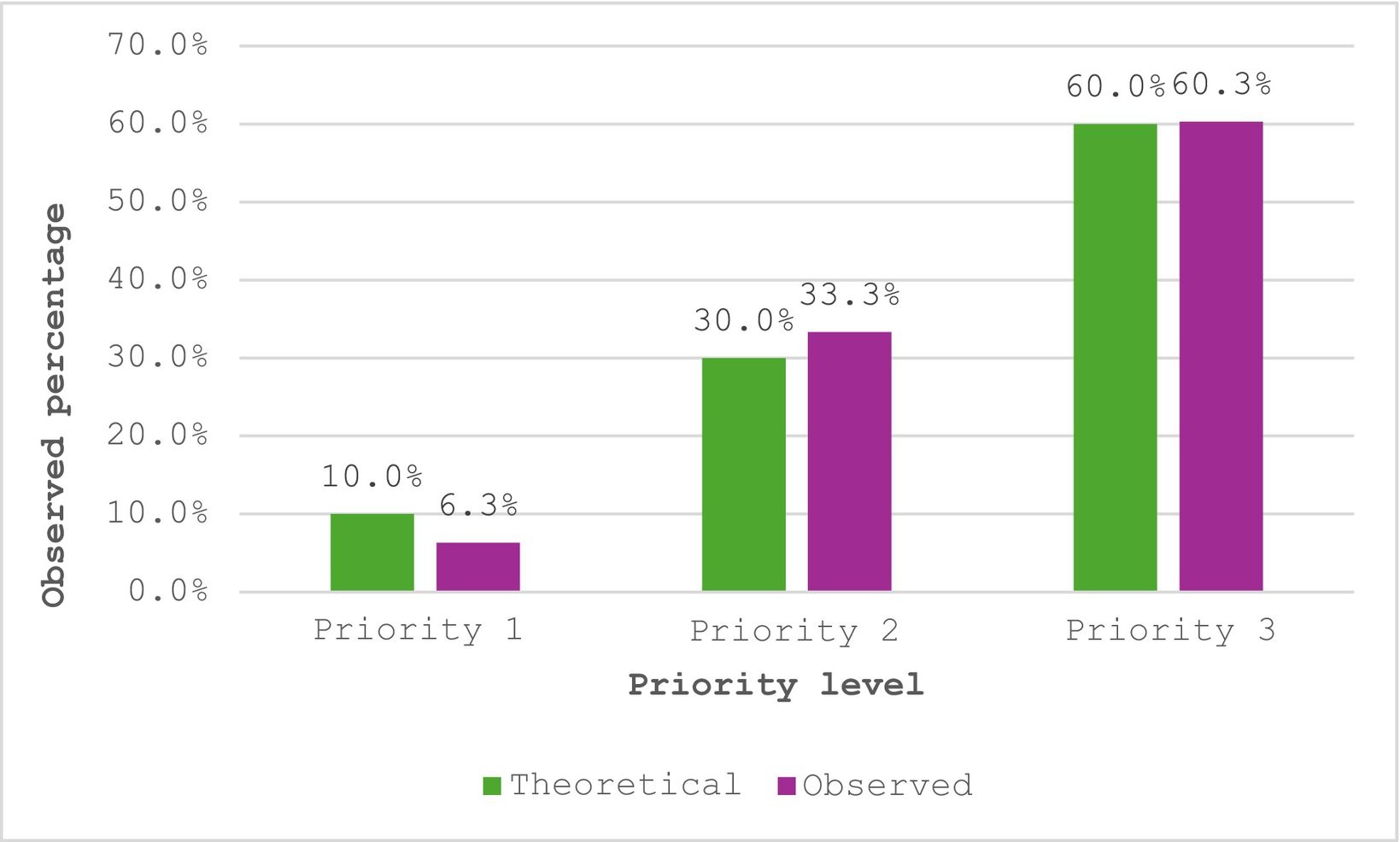
ResultsA total of 126 patients were included (median age 63.2 years (IQR = 58.9–72.5); 69.2% men). The percentages obtained were 6.3% (95% CI: 2.1–10.6%) in priority 1, 33.3% (95% CI: 25.1–41.6%) in priority 2, and 60.3% (95% CI: 51.8–68.8%) in priority 3, with theoretical distribution being 10, 30, and 60%, respectively (p = 0.342).
ConclusionThere is agreement between both distributions, which supports the applicability of the tool in healthcare practice, and it can be used to prioritize resources in outpatient consultations.
analizar la concordancia entre la estratificación ofrecida por la herramienta incluida en la adaptación del modelo capacidad-motivación-oportunidad para pacientes con enfermedades cardiovasculares elaborado por De Dios et al. en 2025 y la obtenida al aplicarla en la práctica clínica.
Métodosestudio observacional, transversal y unicéntrico (de enero a marzo de 2025) en el que se incluyeron pacientes que acudieron a las consultas externas de farmacia hospitalaria y que estaban en tratamiento activo con inhibidores de la proproteína convertasa subtilisina/kexina tipo 9 o inclisirán.
Las variables recogidas para la estratificación fueron variables demográficas, clínicas, farmacoterapéuticas y sociosanitarias. Para la estratificación, se utilizó la adaptación del modelo capacidad-motivación-oportunidad en pacientes con enfermedades cardiovasculares.
Para analizar la concordancia, se utilizó la prueba de chi-cuadrado para una muestra. Los datos fueron procesados con el programa estadístico IBM SPSS Statistics, versión 30.
Resultadosse incluyeron 126 pacientes (mediana de edad 63,2 años, RIQ = 58,9–72,5; 69,2% hombres). Los porcentajes obtenidos fueron del 6,3% (IC 95%: 2,1–10,6) en prioridad 1, del 33,3% (IC 95%: 25,1–41,6) en prioridad 2 y del 60,3% (IC 95%: 51,8–68,8) en prioridad 3, siendo la distribución teórica del 10, 30 y 60%, respectivamente (p = 0,342).
Conclusiónexiste concordancia entre ambas distribuciones, lo que respalda la aplicabilidad de la herramienta en la práctica asistencial, pudiendo ser utilizada para priorizar recursos en las consultas externas.
Since 2012, mortality related to cardiovascular disease (CVD) has decreased, though it continues to be high.1
The Framingham study, supported by other works, contributed to identifying primary cardiovascular risk factors such as hypertension, dyslipidemia, smoking, diabetes mellitus, obesity, sedentary behavior and family history, some of which are modifiable.2,3 Controlling these factors is essential for preventing CVD.4 Dyslipidemia plays a key role, since it can be prevented through the adoption of healthy habits or treated with the available therapeutic armamentarium.5 Current pharmacological therapies are effective in reducing c-LDL—a risk factor and the causal agent of atherosclerosis— by a mean of 50%.6
Since the late ‘90s, a patient-centered approach has been progressively adopted7 leading pharmaceutical care to evolve toward the capability-motivation-opportunity (CMO) model. CMO is based on individualized care built upon three core pillars.8 The “Mapa estratégico de atención al paciente externo [MAPEX]” (Strategic outpatient care pathway) published by the Spanish Society of Hospital Pharmacy (SEFH) in 2016 favored the subsequent development of adaptations of the CMO model to a variety of diseases.9 The latest adaptation is the CMO model for patients with CVD aimed at advancing the management of two challenges: CVD and individualized pharmaceutical care.10,11 Like previous adaptations, this version proposes personalized interventions for CVD patients. These interventions will help reach pharmacotherapeutic goals previously defined during the interview.10
Experiences with the CMO model in routine clinical practice have demonstrated to be beneficial for users of hospital pharmacy services.12 A variety of studies, like the one by Asensi et al.,13 have been conducted to demonstrate the applicability of existing models. However, the stratification tool included in the CMO model for CVD patients has not yet been validated in practice.
This study aimed to assess concordance between stratification offered by the model (theoretical) and stratification obtained upon implementation to validate its applicability.
MethodsAn observational, cross-sectional, single-center study was conducted involving the consecutive use of the tool from January to March 2025.
The sample included patients receiving alirocumab, evolocumab or inclisiran as primary or secondary prevention of atherosclerotic disease attending an outpatient hospital pharmacy service during the study period. Unavailability of patients’ data during the data collection period and previous participation in a clinical trial led to exclusion. Sample size was not estimated, since it was an observational study involving patients seen at an outpatient unit and meeting inclusion criteria.
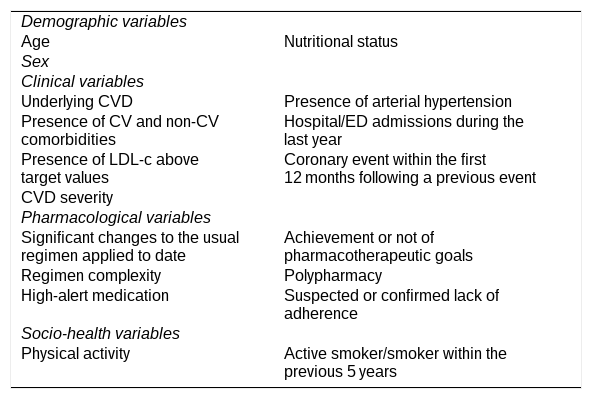
The 2024 CMO version for CVD patients was used for stratification.10 Model variables were collected (Table 1). Prior to the patient's visit, pre-stratification was performed based on data from electronic medical history records (Diraya®). Missing variables were collected through an interview with the patient or their caregivers during routine visits.
Variables included in the capability-motivation-opportunity model for patients with cardiovascular disease.
| Demographic variables | |
| Age | Nutritional status |
| Sex | |
| Clinical variables | |
| Underlying CVD | Presence of arterial hypertension |
| Presence of CV and non-CV comorbidities | Hospital/ED admissions during the last year |
| Presence of LDL-c above target values | Coronary event within the first 12 months following a previous event |
| CVD severity | |
| Pharmacological variables | |
| Significant changes to the usual regimen applied to date | Achievement or not of pharmacotherapeutic goals |
| Regimen complexity | Polypharmacy |
| High-alert medication | Suspected or confirmed lack of adherence |
| Socio-health variables | |
| Physical activity | Active smoker/smoker within the previous 5 years |
CMO: capability-motivation-opportunity; CV: cardiovascular.
The Chi-squared test was used to compare the observed distribution by priority levels with the distribution estimated by the model.14 To this end, the following null hypothesis was formulated: “The percentages obtained for our sample will be consistent with the theoretical percentages.” To accept the null hypothesis, a p > 0.05 value was required. Cohen's kappa coefficient, sensitivity, specificity, and predictive values could not be estimated as an individual classification of patients was not available for use as a reference.
Statistical analysis was performed using the IBM SPSS v.30 software package.
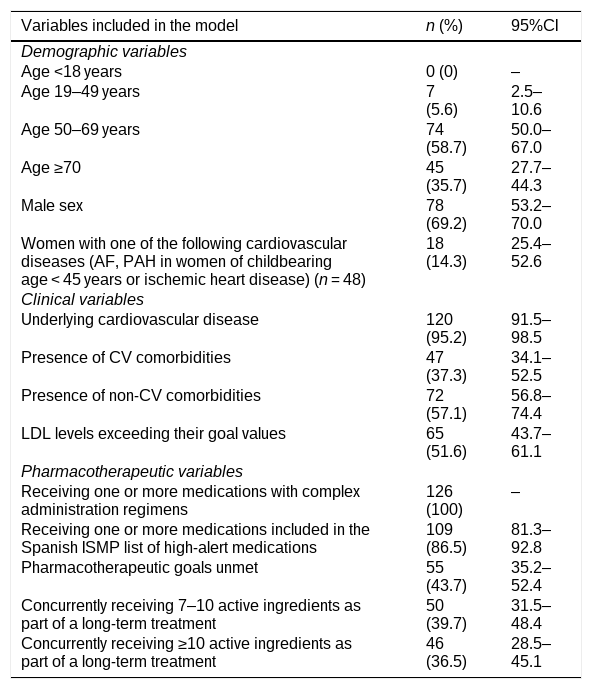
ResultsDuring the study period, a total of 126 patients were stratified, with a median age of 63.2 years (IQR = 58.9–72.5); 78 (69.2%) were men. Table 2 describes the baseline characteristics of the study population. In total, 98 patients (77.8%) were receiving alirocumab; 16 (12.7%) evolocumab; and 12 inclisiran (9.5%).
Patient distribution according to the variables included in the modified capability-motivation-opportunity model for cardiovascular diseases (n = 126).
| Variables included in the model | n (%) | 95%CI |
|---|---|---|
| Demographic variables | ||
| Age <18 years | 0 (0) | – |
| Age 19–49 years | 7 (5.6) | 2.5–10.6 |
| Age 50–69 years | 74 (58.7) | 50.0–67.0 |
| Age ≥70 | 45 (35.7) | 27.7–44.3 |
| Male sex | 78 (69.2) | 53.2–70.0 |
| Women with one of the following cardiovascular diseases (AF, PAH in women of childbearing age < 45 years or ischemic heart disease) (n = 48) | 18 (14.3) | 25.4–52.6 |
| Clinical variables | ||
| Underlying cardiovascular disease | 120 (95.2) | 91.5–98.5 |
| Presence of CV comorbidities | 47 (37.3) | 34.1–52.5 |
| Presence of non-CV comorbidities | 72 (57.1) | 56.8–74.4 |
| LDL levels exceeding their goal values | 65 (51.6) | 43.7–61.1 |
| Pharmacotherapeutic variables | ||
| Receiving one or more medications with complex administration regimens | 126 (100) | – |
| Receiving one or more medications included in the Spanish ISMP list of high-alert medications | 109 (86.5) | 81.3–92.8 |
| Pharmacotherapeutic goals unmet | 55 (43.7) | 35.2–52.4 |
| Concurrently receiving 7–10 active ingredients as part of a long-term treatment | 50 (39.7) | 31.5–48.4 |
| Concurrently receiving ≥10 active ingredients as part of a long-term treatment | 46 (36.5) | 28.5–45.1 |
CMO: capability-motivation-opportunity; AF: atrial fibrillation; PaH: pulmonary arterial hypertension; ISMP: Institute for Safe Medication Practices; LDL: Low-density lipoprotein.
The table displays only the model variables with a nonzero score in at least one patient in the cohort. Variables not shown in the table scored zero in all patients.
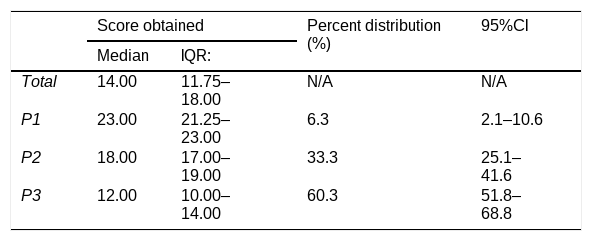
Table 3 contains the median score, interquartile ranges (IQRs), percentages and confidence intervals by priority group and for the total of patients. A descending score was observed from P1 to P3. The scores of most patients fell within P3, followed by P2 and P1 (Fig. 1).
Median scores and interquartile ranges for the total number of patients and by priority group according to the CMO model. Percent distribution and confidence intervals by priority level following patient stratification.
| Score obtained | Percent distribution (%) | 95%CI | ||
|---|---|---|---|---|
| Median | IQR: | |||
| Total | 14.00 | 11.75–18.00 | N/A | N/A |
| P1 | 23.00 | 21.25–23.00 | 6.3 | 2.1–10.6 |
| P2 | 18.00 | 17.00–19.00 | 33.3 | 25.1–41.6 |
| P3 | 12.00 | 10.00–14.00 | 60.3 | 51.8–68.8 |
IQR: interquartile range; 95%CI: 95% confidence interval; N/A: Not applicable; P1: Priority 1; P2: Priority 2; P3: Priority 3.
Considering that the percent distribution estimated by the model was 10% of patients would be classified as P1, 30% as P2, and 60% as P3.12 The one-sample Chi-square test yielded a p = 0.342 (p > 0.05).
DiscussionThis study is the first to validate in clinical practice the recently modified stratification model for patients with CVD within the 2024–2027 MAPEX framework. Statistical analysis demonstrated good concordance between the percentages obtained with the model and the observed percent distribution following application of the stratification tool to a cohort of real patients (p = 0.342).
When compared with the pilot study conducted by Dios López et al., 2025, during development of the stratification tool, the percent distributions between the two studies show close alignment (6.3% P1, 33.3% P2 and 60.3% P3 versus 10% P1, 30% P2 and 60% P3 of the model); nevertheless, a slight difference was observed in the P1 patient group.11 This difference might be explained by the profile of patients included in each study. Our study involved patients with high clinical and pharmacotherapeutical complexity (39.7% 7–10 active ingredients; 36.5% ≥10 active ingredients), which could drive results to higher levels of priority.
Confirming the applicability of this tool will enable hospital pharmacists to optimize healthcare and scheduling resources by prioritizing patients with greater complexity, while also facilitating tailored interventions and remote patient monitoring. The role of “capability” as the first step toward personalized pharmaceutical care should not outshine the relevance of the other pillars “motivation” and “opportunity”. In line with the study published by Van den Berg et al. (2019),4 improving communication with the patient and motivation contribute to cessation of smoking habits—a major risk factor in the development of CVD, key to improving prognosis. These findings support applying the CMO model in this patient group to guide pharmaceutical interventions aimed at improving treatment adherence, LDL-c control, and reducing CV events.
The single-center design, short study period (3 months) and focus on patients receiving iPCSK9 or inclisiran as primary or secondary prevention of atherosclerotic disease limit the generalization of results. Validating a tailored CMO model for patients with CVD will enable the development of personalized interventions. However, this study is limited to stratification and concordance analysis with the original tool; therefore, it is not possible to assess whether full implementation of the model improves clinical outcomes, adherence, or quality of life. The slight deviation of our patient group toward P1 could entail selection bias or reflect the particularities of our study population, who were receiving subcutaneous treatment.
Further studies are needed to validate the model in multicenter studies involving more heterogeneous populations. It is necessary to further investigate whether stratification of this patient population predicts clinical outcomes such as the occurrence of CV events, the probability of admission, improvements in quality of life, and adherence. The results of future studies could help professionals anticipate the occurrence of complications and proactively implement preventive interventions. Another avenue for future research is the application of interventions by priority level to assess its impact on adherence, LDL-c control, CV events, and health educations, which is crucial for prognosis.
ConclusionThe stratification tool for patients with CVDs is consistent with expected distribution, thereby confirming its utility for patient prioritization. The implementation and extension of this tool would contribute to improving healthcare efficiency and personalized pharmaceutical care.
Artificial intelligence use statementNotebookLM was used to select records for full-text reading for inclusion as a reference. Connected Papers was used to search papers related with records previously found on PubMed.
CRediT authorship contribution statementCecilia Solís-Martín: Writing – original draft, Formal analysis, Data curation, Conceptualization. Ramón Morillo-Verdugo: Writing – review & editing, Validation, Supervision, Methodology, Formal analysis, Conceptualization.
Ethical considerationsThis study was conducted during routine clinical practice without involving any intervention on patients; therefore, obtaining informed consent was not required (CEI Sevilla Sur – SICEIA-2025-003781).
FundingThis study did not receive any funding.
The authors confirm that there are no known conflicts of interest associated with this publication.