


Flumazenil is commonly used as an antidote for benzodiazepine overdose. However, information regarding dosing practices in hospital emergency departments remains limited. This study aimed to identify the clinical factors associated with the administration of higher flumazenil doses in the emergency department setting.
MethodsThis was a retrospective observational study. Adult patients treated with flumazenil in eighteen Spanish emergency departments during 2023 were included. Patient comorbidities, drugs and toxics involved in the intoxication, and the doses of flumazenil administered were recorded. A logistic regression model was used to assess factors associated with increased dosing (>0.5 mg).
ResultsA total of 798 patients were included [51.4 years (SD: 21.4), 457 (57.3%) female]. Benzodiazepine intoxication was confirmed in 513 cases (64.3%). In addition, 45 (8.9%) patients presented concomitant intoxication with opioids, and 117 patients (22.8%) had concurrent alcohol use. The median dose of flumazenil was 0.75 mg (range: 0.125–23.1). In 338 patients (42.4%), flumazenil was delivered via continuous infusion. In the multivariate model, a significant association with higher dose was found with age younger than 65 years [OR: 2.12 (1.50–3.00)] and chronic benzodiazepine use [OR: 1.69 (1.22–2.35)].
ConclusionsFlumazenil dosing in emergency department is highly variable. Increased dose requirements were observed in younger patients and chronic benzodiazepine use.
Flumazenilo es un fármaco ampliamente utilizado en las intoxicaciones por benzodiazepinas. No obstante, la información sobre las diferencias en la dosificación utilizada en los servicios de urgencias hospitalarios sigue siendo escasa. El objetivo de este estudio fue identificar los factores asociados con la necesidad de dosis más altas de flumazenilo en los servicios de urgencias.
MétodosEstudio observacional retrospectivo. Se incluyeron pacientes adultos tratados con flumazenilo en dieciocho servicios de urgencias españoles durante 2023. Se registraron las comorbilidades de los pacientes, los fármacos y tóxicos implicados en la intoxicación, y las dosis de flumazenilo administradas. Se utilizó un modelo de regresión logística para evaluar los factores asociados con la necesidad de dosis elevadas de flumazenilo (>0,5 mg).
ResultadosSe incluyeron 798 pacientes [51,4 años (DE: 21,4), 457 (57,3%) mujeres]. La intoxicación por benzodiazepinas fue confirmada en 513 (64,3%) casos. De ellos, 45 (8,9%) presentaron intoxicación concomitante con opioides y 117 pacientes (22,8%) con alcohol. La dosis mediana de flumazenilo fue de 0,75 mg (rango: 0,125–23,1). En 338 pacientes (42,4%), el flumazenilo se administró mediante infusión continua. En el modelo multivariable, se observó una asociación significativa entre dosis más elevadas y la edad menor de 65 años [OR: 2,12 (1,50–3,00)] y el consumo crónico de benzodiazepinas [OR: 1,69 (1,22–2,35)].
ConclusionesLa dosificación de flumazenilo en los pacientes intoxicados tratados en los servicios de urgencias es muy variable, observándose unos mayores requerimientos de dosis en pacientes jóvenes y con consumo crónico de benzodiazepinas.
Benzodiazepine intoxication, whether occurring in isolation or in combination with other substances, is a common reason for visits to hospital emergency departments (ED).1,2 Typically, these patients show a decreased level of consciousness that can last anywhere from a few hours to several days. The exact duration is primarily tied to the half-life of the specific benzodiazepine they took.3 When benzodiazepines are the only substance involved, such cases are rarely fatal. However, mortality tends to increase significantly in cases of mixed intoxication, involving benzodiazepines together with other medications, illicit drugs, or alcohol.4–6
Flumazenil, the main pharmacological treatment for benzodiazepine intoxication, acts by reversibly blocking specific benzodiazepine receptors and has weak intrinsic activity on the GABA-A receptor complex.7 It is specifically indicated in cases of benzodiazepine overdose that present with significant alterations in the level of consciousness and life-threatening respiratory depression.8
Despite the extensive clinical experience with flumazenil in the management of benzodiazepine intoxication, a high variability in dosing used to treat intoxication has been reported,9 and specific factors associated with the need for an increased dose remain unclear. Therefore, the aim of the present study was to determine the risk factors associated with high doses of flumazenil administration, and to analyze their relationship with the use of the drug under non-recommended conditions.
Material and methodsStudy designA retrospective observational study was conducted across eighteen emergency departments (EDs) in Spanish hospitals. The study population included patients over 18 years of age who were treated in the ED during 2023 and received flumazenil due to suspected drug intoxication. Patients who were administered flumazenil outside the ED setting or in contexts unrelated to suspected overdose were excluded. To identify adverse events, investigators retrospectively reviewed the ED discharge reports. In cases where no diagnosis was explicitly recorded, clinical notes, laboratory and diagnostic test results, and administered medications were also assessed.
Data collected included age, biological sex, patient origin, comorbidities, number of outpatient medications (according to electronic prescriptions or referring center reports), discharge destination, and substances or drugs involved in the intoxication episode. Additionally, the dose of flumazenil received and the route of administration, either as a bolus or continuous infusion, were recorded.
An analysis was performed to identify factors associated with the administration of flumazenil at doses greater than 0.5 mg. The variables assessed included age, sex, number of chronic medications at admission, history of epilepsy, diabetes, chronic kidney disease (stages III–V),10 chronic obstructive pulmonary disease (COPD), psychiatric disorders, and concomitant intoxication with alcohol, tricyclic antidepressants, or drugs of abuse. The total dose of flumazenil administered was also considered. The effect of continuous infusion on the frequency of adverse events and length of ED stay was also explored. Because flumazenil is often administered initially as a bolus followed by continuous infusion when the response is insufficient or short-lived, both strategies were not considered mutually exclusive. For the analysis, any patient receiving continuous infusion at any point during ED care was classified in the continuous infusion group. Data were collected using the REDCap® platform.
Statistical analysisQuantitative variables were described using measures of central tendency (mean or median) along with measures of dispersion (standard deviation or interquartile range). Categorical variables were presented as absolute frequencies and percentages. Comparisons between study groups over time were conducted using analysis of variance (ANOVA) for continuous variables and the Chi-square test for categorical variables.
To identify factors associated with the need for increased doses of flumazenil (>0.5 mg), a multivariate logistic regression model was developed. Variables with a p-value <0.100 in the previous univariate analysis were included in the final model. The variables assessed included age over 65 years, sex, severe polypharmacy (defined as the use of 10 or more medications),11 relevant comorbidities (such as chronic kidney disease, epilepsy, or psychiatric disorders), presence of concomitant toxic substances, the type of drugs involved in the intoxication, as well as the flumazenil administration method (bolus or continuous infusion) and the total dose administered. Statistical analysis was performed using Stata software version 16.0 (StataCorp, TX, USA).
The study was approved by the ethics committee of the participating centers (Reference code IIBSP-FLU-2022-143). A waiver of informed consent was requested, as this was a retrospective, non-interventional study.
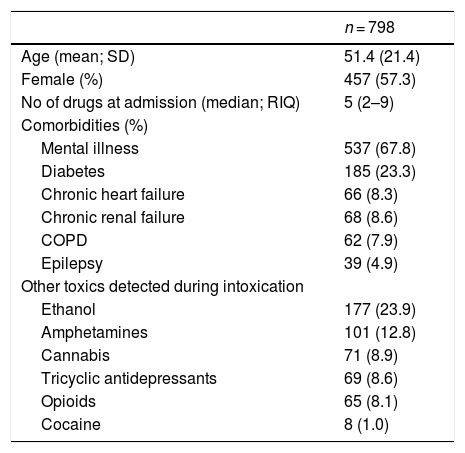
ResultsA total of 798 patients were included in the analysis, with a mean age of 51.4 years (SD: 21.4), and 457 (57.3%) were female. The main demographic, clinical characteristics and toxics involved in the episode are presented in Table 1. Benzodiazepines were part of the home medication regimen in 578 patients (72.5%).
Characteristics of patients included in the study.
| n = 798 | |
|---|---|
| Age (mean; SD) | 51.4 (21.4) |
| Female (%) | 457 (57.3) |
| No of drugs at admission (median; RIQ) | 5 (2–9) |
| Comorbidities (%) | |
| Mental illness | 537 (67.8) |
| Diabetes | 185 (23.3) |
| Chronic heart failure | 66 (8.3) |
| Chronic renal failure | 68 (8.6) |
| COPD | 62 (7.9) |
| Epilepsy | 39 (4.9) |
| Other toxics detected during intoxication | |
| Ethanol | 177 (23.9) |
| Amphetamines | 101 (12.8) |
| Cannabis | 71 (8.9) |
| Tricyclic antidepressants | 69 (8.6) |
| Opioids | 65 (8.1) |
| Cocaine | 8 (1.0) |
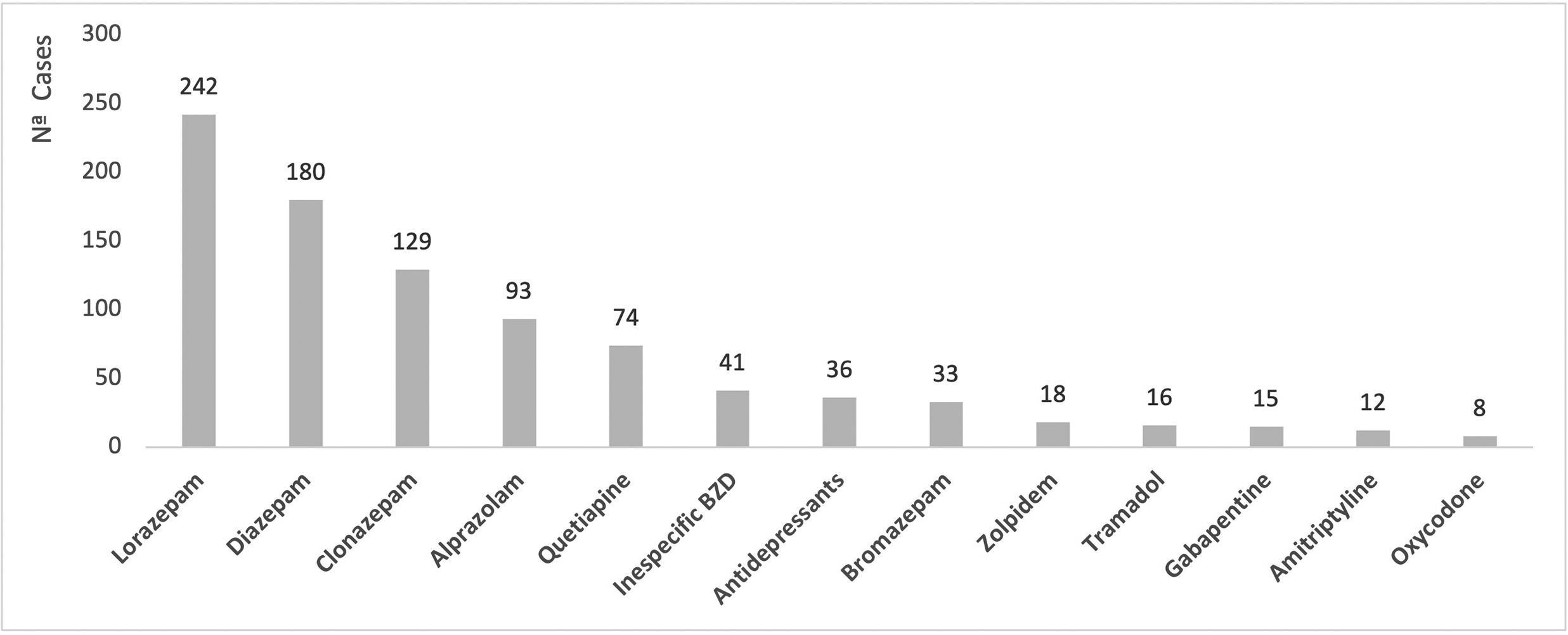
Benzodiazepine intoxication was confirmed in 513 cases (64.3%). A notable proportion of patients presented with mixed substance intoxications (benzodiazepine and other drug): 63 (12.2%) with amphetamines, 45 (8.8%) with opioids, 45 (8.8%) with tricyclic antidepressants, 39 (7.6%) with cannabinoids and 6 (1.1%) with cocaine. Additionally, 117 patients (22.8%) had concurrent alcohol use. The main drugs involved in the intoxication episodes are summarized in Fig. 1. A history of epilepsy was documented in 39 patients (4.9%), and 34 of them (4.3%) were under benzodiazepine treatment. Regarding mortality, five patients (0.6%) died during hospitalization within 30 days of their ED visit.
The median dose of flumazenil administered was 0.75 mg (range: 0.125–23.1). In 338 patients (42.4%), flumazenil was delivered via continuous infusion at some point during ED stay, with a median duration of 5 h (range: 0.45–49 h). Those patients with flumazenil dose >0.5 mg presented a higher frequency of adverse events (70.3% vs 29.7%; p = 0.004), being anxiety (n = 23) and seizures (n = 13), the most frequent adverse events reported. Continuous infusion was associated with longer ED length of stay (21.7 (SD: 14.9) vs 16.2 (15.0) h; p < 0.001) and higher frequency of adverse events (54.5% vs 41.3%; p = 0.032).
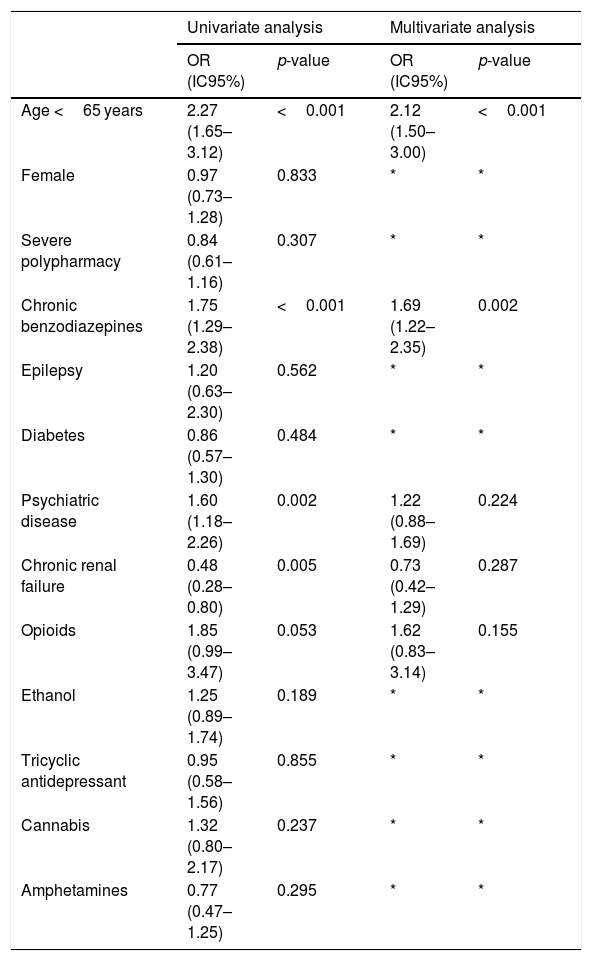
In the univariate analysis, the variables of age younger than 65 years, chronic benzodiazepine use, psychiatric disease, and concomitant intoxication with opioids were associated with higher flumazenil dose requirements (Table 2). In the multivariate model, a significant association was found with the variables of age younger than 65 years [OR: 2.12 (1.50–3.00)], and chronic benzodiazepine use [OR: 1.69 (1.22–2.35)].
Results of the univariate and multivariate analysis for risk factors associated with flumazenil dose >0.5 mg.
| Univariate analysis | Multivariate analysis | |||
|---|---|---|---|---|
| OR (IC95%) | p-value | OR (IC95%) | p-value | |
| Age <65 years | 2.27 (1.65–3.12) | <0.001 | 2.12 (1.50–3.00) | <0.001 |
| Female | 0.97 (0.73–1.28) | 0.833 | * | * |
| Severe polypharmacy | 0.84 (0.61–1.16) | 0.307 | * | * |
| Chronic benzodiazepines | 1.75 (1.29–2.38) | <0.001 | 1.69 (1.22–2.35) | 0.002 |
| Epilepsy | 1.20 (0.63–2.30) | 0.562 | * | * |
| Diabetes | 0.86 (0.57–1.30) | 0.484 | * | * |
| Psychiatric disease | 1.60 (1.18–2.26) | 0.002 | 1.22 (0.88–1.69) | 0.224 |
| Chronic renal failure | 0.48 (0.28–0.80) | 0.005 | 0.73 (0.42–1.29) | 0.287 |
| Opioids | 1.85 (0.99–3.47) | 0.053 | 1.62 (0.83–3.14) | 0.155 |
| Ethanol | 1.25 (0.89–1.74) | 0.189 | * | * |
| Tricyclic antidepressant | 0.95 (0.58–1.56) | 0.855 | * | * |
| Cannabis | 1.32 (0.80–2.17) | 0.237 | * | * |
| Amphetamines | 0.77 (0.47–1.25) | 0.295 | * | * |
The present study provides valuable insights into the factors associated with increased flumazenil dosing requirements in the emergency setting. Our findings demonstrate that certain patient characteristics, specifically younger age (<65 years) and chronic benzodiazepine use, are significantly associated with the need for higher doses of flumazenil. Moreover, higher doses were associated with an increased risk of adverse events, a clinically relevant finding that warrants careful consideration in emergency settings.
Our findings are consistent with previous reports describing substantial variability in flumazenil dosing strategies in emergency and toxicology settings.9,12 Earlier studies already suggested that patients with chronic benzodiazepine exposure may require higher cumulative doses or prolonged administration because of pharmacodynamic tolerance and receptor adaptation.13,14 More recent publications have also emphasized the role of individualized dosing strategies and continuous infusion in selected cases of persistent or recurrent sedation, particularly when the duration of toxicity exceeds the half-life of a single flumazenil bolus.15,16
The results show that chronic benzodiazepine is an independent predictor of higher flumazenil dosing. This is not surprising given the pharmacological basis of tolerance in chronic users, who typically exhibit receptor downregulation and altered GABAergic neurotransmission.17 As a result, higher antagonist doses may be necessary to achieve adequate receptor occupancy and clinical reversal in these patients. However, this practice carries an inherent risk. Flumazenil administration in chronic benzodiazepine users is often cautioned against, due to the risk of precipitating withdrawal seizures and acute withdrawal syndromes.18,19 In our cohort, higher doses of flumazenil were indeed associated with a higher incidence of adverse events, particularly anxiety and seizures. This underscores the need for caution and individualized risk assessment when administering flumazenil to this subgroup.
The association between chronic benzodiazepine use and higher dose requirements observed in our study is biologically plausible and clinically relevant. Chronic exposure to benzodiazepines may lead to reduced responsiveness to standard reversal doses, while also increasing the risk of withdrawal symptoms and seizures after antagonist administration.13,20 This dual effect probably explains why these patients often represent the most challenging subgroup for flumazenil use in routine emergency practice.
The association between younger age and higher flumazenil doses is also noteworthy. It may reflect differences in benzodiazepine receptor sensitivity or metabolic capacity between younger and older individuals. Alternatively, it is possible that clinicians might have been more inclined to use aggressive reversal strategies in younger patients, anticipating better tolerance to potential adverse effects.21 This potential bias in clinical decision-making could influence dosing patterns and should be further explored through prospective studies.
The observation that continuous infusion of flumazenil was employed in over a third of patients also reflects the diverse strategies in clinical practice for managing persistent or severe intoxications. Continuous infusion allows for a more controlled and sustained reversal of benzodiazepine effects, potentially minimizing the risk of abrupt withdrawal symptoms.9,22 However, in our study, patients receiving continuous infusions experienced longer stays in the emergency department, suggesting that while this approach may be safer in some respects, it may also be associated with prolonged monitoring requirements and resource utilization.
Interestingly, while the univariate analysis highlighted several variables associated with increased flumazenil dosing, including psychiatric disease and concomitant opioid intoxication, these factors did not retain significance in the multivariate model. This suggests that while comorbid conditions and poly-drug intoxications are relevant to the overall clinical picture, they may not independently drive the need for higher flumazenil doses once other factors such as age, sex, and chronic benzodiazepine use are accounted for.
Our study also highlights the clinical implications of higher flumazenil doses. Patients receiving more than 0.5 mg of flumazenil had a significantly higher frequency of adverse events. This finding is clinically significant and emphasizes the delicate balance between achieving effective reversal of sedation and avoiding the precipitating of iatrogenic complications.23 It reinforces the importance of adhering to cautious dosing protocols and vigilant monitoring, particularly in populations identified as higher risk.
Several limitations of our study should be acknowledged. First, its retrospective design inherently limits the ability to establish causality, and potential confounding factors may not have been fully accounted for despite multivariate adjustments. Second, dosing decisions in the emergency setting are influenced by clinical judgment and may be subject to provider variability, which could introduce bias. Third, our analysis was confined to doses administered and immediate outcomes within the ED, without long-term follow-up to assess delayed adverse events or outcomes. Despite these limitations, the multicenter nature of the study, encompassing data from eighteen ED, strengthens the generalizability of the findings within similar healthcare settings.
From a clinical perspective, our findings suggest the need for more standardized guidelines on flumazenil dosing, particularly in patients with identified risk factors such as younger age and chronic benzodiazepine use. Tailored protocols that consider these variables could help optimize patient safety while ensuring effective management of benzodiazepine intoxications.14 Furthermore, our results advocate for heightened caution in patients with chronic benzodiazepine use, where the threshold for using flumazenil—especially at higher doses—should be carefully weighed against the risk of withdrawal seizures. Alternative supportive measures and prolonged observation may be more appropriate in certain cases.
In conclusion, this study contributes to a better understanding of the determinants of flumazenil dosing in the ED. Identifying patients who are more likely to require higher doses allows clinicians to anticipate potential risks and tailor interventions accordingly. Future prospective studies are needed to validate these findings and to develop evidence-based protocols that ensure both efficacy and safety in the use of flumazenil for benzodiazepine intoxication in the acute care setting.
Contribution to the scientific literatureThis study provides real-world evidence on flumazenil dosing patterns in the ED, an area that remains poorly described despite the widespread use of this antidote. Our findings identify younger age and chronic benzodiazepine use as independent predictors of higher flumazenil requirements, helping to better characterize the clinical profile of patients more likely to need dose escalation. In addition, the study highlights the marked variability in dosing strategies and the association between higher doses and adverse events, supporting the need for more standardized and individualized approaches to flumazenil use in acute care settings.
Use of artificial generative intelligenceThe authors declare that, during the production process of this work, we use artificial generative intelligence (AI), specifically ChatGPT (Open AI), in the best language of text sections. Authors have carefully reviewed and validated all content generated with IA assistance, guaranteed accuracy, coherence and originality; assuming full responsibility for the content of the publication.
Ethical responsibilitiesAll authors have confirmed the maintenance of confidentiality and respect for patients' complaints in the author's document of responsibility, acknowledgment of publication and transfer of complaints to Medicina Clinic. The study was approved by the Ethical and Clinical Investigation Committees of the participating centers.
FinancingThe authors declare that no financial support was received for the research, authorship, and/or publication of this article.
Authors declare no conflict of interests.