


Biologic therapies targeting interleukin IL-17, IL-23 and IL-12/23 have substantially improved outcomes in patients with moderate-to-severe psoriasis. In real-world settings, treatment effectiveness depends not only on drug efficacy but also on patient adherence, which is essential for the appropriate interpretation of treatment persistence.
The objectives of the present study were to evaluate adherence to biologic therapy with IL-17 inhibitors, IL-23 inhibitors and IL-12/23 inhibitors in patients with moderate-to-severe psoriasis in real-world clinical practice and to identify factors associated with high adherence.
MethodsA retrospective, multicenter observational study was conducted in one tertiary hospital and two regional hospitals within the same regional public healthcare system. Adult patients with moderate-to-severe psoriasis treated with IL-17 inhibitors, IL-23 inhibitors or IL-12/23 inhibitors for at least 4 months were included. Adherence was assessed using the medication possession ratio (MPR), calculated as the mean adherence across all dispensations recorded between December 2009 and October 2025. Multivariable logistic regression (with patient-level clustering to account for repeated courses) identified factors associated with excellent adherence (MPR ≥90%).
ResultsA total of 423 patients and 626 treatment courses were included. Mean overall adherence was 94.5%. Adherence ≥80% was observed in 97.4% of treatment courses, and 78.8% achieved adherence ≥90%. Older age, female sex and treatment with IL-23 inhibitors were independently associated with excellent adherence.
ConclusionsAdherence to biologic therapies targeting interleukin IL-17, IL-23 and IL-12/23 in patients with moderate-to-severe psoriasis managed in hospital settings for at least 4 months is very high. Systematic assessment of adherence is essential for interpreting clinical outcomes and is essential for persistence analyses.
Las terapias biológicas dirigidas frente a las interleucinas IL-17, IL-23 e IL-12/23 han mejorado sustancialmente los resultados clínicos en pacientes con psoriasis moderada-grave. En la práctica clínica real, la efectividad del tratamiento depende no solo de la eficacia del fármaco, sino también de la adherencia del paciente, un factor clave para la adecuada interpretación de la persistencia terapéutica. Los objetivos de este estudio fueron evaluar la adherencia a los inhibidores de IL-17, IL-23 e IL-12/23 en pacientes con psoriasis moderada-grave en condiciones de práctica clínica habitual e identificar los factores asociados a una elevada adherencia.
MétodosSe realizó un estudio observacional retrospectivo multicéntrico en un hospital terciario y dos hospitales comarcales pertenecientes al mismo sistema sanitario público regional. Se incluyeron pacientes adultos con psoriasis moderada-grave tratados con inhibidores de IL-17, IL-23 o IL-12/23 durante al menos 4 meses. La adherencia se evaluó mediante la razón de posesión de medicación (Medication Possession Ratio, MPR), calculada como la adherencia media de todas las dispensaciones registradas entre diciembre de 2009 y octubre de 2025. Los factores asociados a una adherencia excelente (MPR ≥90%) se identificaron mediante regresión logística multivariable con agrupación por paciente para considerar cursos terapéuticos repetidos.
ResultadosSe incluyeron 423 pacientes y 626 cursos de tratamiento. La adherencia media global fue del 94,5%. El 97,4% de los tratamientos presentaron una adherencia ≥80% y el 78,8% alcanzaron una adherencia ≥90%. La mayor edad, el sexo femenino y el tratamiento con inhibidores de IL-23 se asociaron de forma independiente con una adherencia excelente.
ConclusionesLa adherencia a los inhibidores de IL-17, IL-23 e IL-12/23 en pacientes con psoriasis moderada-grave atendidos en el ámbito hospitalario durante al menos 4 meses es muy elevada. La evaluación sistemática de la adherencia resulta fundamental para interpretar adecuadamente los resultados clínicos y constituye un elemento esencial en los análisis de persistencia terapéutica.
Psoriasis is a chronic inflammatory disease that requires long-term treatment to maintain optimal disease control. In patients with moderate-to-severe disease, biologic therapies targeting specific inflammatory pathways, particularly interleukin (IL)-12, IL-17 and IL-23, have led to substantial improvements in efficacy and safety compared with conventional systemic treatments.1 In our setting, these biologic agents are hospital-dispensed medications and are managed through the outpatient units of hospital pharmacy services, where patients are followed by specialist hospital pharmacists, who play a key role in pharmacotherapeutic monitoring and in promoting treatment adherence.
Clinical response in psoriasis is commonly evaluated using standardized outcome measures. The Psoriasis Area and Severity Index (PASI) assesses disease severity and extent (Range: 0 indicating no disease activity to 72 indicating maximal disease severity), Body Surface Area (BSA) estimates the percentage of affected skin (0–100%), and the Dermatology Life Quality Index (DLQI) (range: 0 indicating no impairment to 30 indicating maximum impairment) evaluates the impact of psoriasis on patients' quality of life. Severe psoriasis is defined as PASI ≥10, BSA ≥10% or DLQI ≥10.2
Medication adherence is an important determinant of real-world treatment effectiveness. The World Health Organization defines adherence as the extent to which a patient's behavior corresponds with agreed recommendations from a healthcare provider.3 In chronic diseases, suboptimal adherence has been consistently associated with poorer clinical outcomes, increased healthcare utilization and higher costs.4
From a methodological perspective, adherence is also a critical prerequisite for the appropriate evaluation of treatment persistence. Assessing persistence without adequately accounting for adherence may lead to misleading conclusions, particularly for biologic therapies administered intermittently and associated with high economic impact.5,6
Indirect adherence measures based on dispensing data, such as the medication possession ratio (MPR), have been widely used in chronic inflammatory diseases and have shown acceptable performance in real-world studies of biologic therapies.7 However, data on adherence in psoriasis remain heterogeneous, and multicenter studies including different levels of care are limited.
The primary objective of this study was to evaluate adherence to biologic therapy with IL-17 inhibitors, IL-23 inhibitors and IL-12/23 inhibitors in patients with moderate-to-severe psoriasis in real-world clinical practice.
The secondary objective was to identify demographic, clinical and treatment-related factors associated with excellent adherence.
MethodsStudy design and populationA retrospective, multicenter observational study was conducted in one tertiary hospital and two regional hospitals within the same regional public healthcare system. Dispensing records were available from December 2009 to October 2025. Biologic treatment courses were included from the date each biologic was first introduced into routine clinical practice at the participating centers until October 2025.
Adult patients with moderate-to-severe psoriasis treated with IL-17 inhibitors (secukinumab, ixekizumab, bimekizumab and brodalumab), IL-23 inhibitors (guselkumab, risankizumab and tildrakizumab) or IL-12/23 inhibitors (ustekinumab) and dispensed through hospital pharmacy services were included. Tumor necrosis factor inhibitors were not included because the study was specifically designed to evaluate adherence to the most recently introduced biologic classes for psoriasis. A minimum treatment duration of 4 months was required to ensure that adherence was assessed after completion of the induction phase and to avoid including treatment courses with only one or two dispensations, which may not accurately reflect long-term adherence behavior.
Variables collectedDemographic (age, sex), clinical (comorbidities including hypertension, diabetes mellitus, dyslipidemia and cardiovascular disease, baseline and follow-up PASI, BSA and DLQI), and treatment-related variables (biologic drug, dosing interval, line of therapy, treatment intensification or optimization) were recorded.
Adherence assessmentAdherence was assessed using the medication possession ratio (MPR), defined as (days covered by dispensed medication ÷ total follow-up days) × 100. MPR is one of the most widely used adherence measures in pharmacoepidemiologic studies based on dispensing databases and has shown acceptable performance in chronic inflammatory diseases.4 Days covered were derived from dispensing dates and the label-recommended dosing interval for each biologic therapy, taking into account the different dosing schedules of the included treatments. For each patient, mean adherence across all recorded dispensations during the study period was calculated. Adherence ≥80% was considered adequate, and adherence ≥90% was defined as excellent.8,9
The standard dosing interval for each biologic agent corresponded to the maintenance regimen approved in the summary of product characteristics. Any planned extension or shortening of this interval was considered dose optimization or intensification, respectively. When calculating the medication possession ratio (MPR), the individualized prescribed dosing schedule, including any optimization or intensification, was used rather than the standard maintenance regimen.
Statistical analysisDescriptive analyses and non-parametric comparisons were performed. Multivariable logistic regression analysis was conducted to identify factors independently associated with excellent adherence. Results are presented as odds ratios (ORs) with 95% confidence intervals (95% CI). Because some patients received more than one treatment course, we used robust standard errors clustered by patient to account for within-patient correlation.
Missing data were handled using complete-case analysis. Variables with missing values were not imputed, and each analysis included only treatment courses with available data for the variables of interest. The amount of missing data was low and mainly affected baseline clinical variables (PASI, BSA and DLQI).
Ethics statementThis study was reviewed and approved by the Ethics Committee for Research with Medicines of the Community of Navarra (CEIm-NA) (approval number: EO_2025/14 EX, date: 11/07/2025) and conducted in accordance with the principles of the Declaration of Helsinki. The requirement for informed consent was waived due to the retrospective, non-interventional design and use of anonymized data (RESOLUTION 2707E/2025).
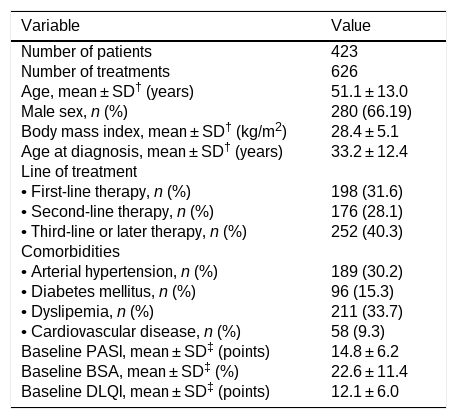
ResultsA total of 423 patients and 626 treatment courses were included. Of these, 66.2% were male, with a mean age of 51.1 ± 13.0 years. Baseline characteristics are summarized in Table 1.
Baseline characteristics of the study population.
| Variable | Value |
|---|---|
| Number of patients | 423 |
| Number of treatments | 626 |
| Age, mean ± SD† (years) | 51.1 ± 13.0 |
| Male sex, n (%) | 280 (66.19) |
| Body mass index, mean ± SD† (kg/m2) | 28.4 ± 5.1 |
| Age at diagnosis, mean ± SD† (years) | 33.2 ± 12.4 |
| Line of treatment | |
| • First-line therapy, n (%) | 198 (31.6) |
| • Second-line therapy, n (%) | 176 (28.1) |
| • Third-line or later therapy, n (%) | 252 (40.3) |
| Comorbidities | |
| • Arterial hypertension, n (%) | 189 (30.2) |
| • Diabetes mellitus, n (%) | 96 (15.3) |
| • Dyslipemia, n (%) | 211 (33.7) |
| • Cardiovascular disease, n (%) | 58 (9.3) |
| Baseline PASI, mean ± SD‡ (points) | 14.8 ± 6.2 |
| Baseline BSA, mean ± SD‡ (%) | 22.6 ± 11.4 |
| Baseline DLQI, mean ± SD‡ (points) | 12.1 ± 6.0 |
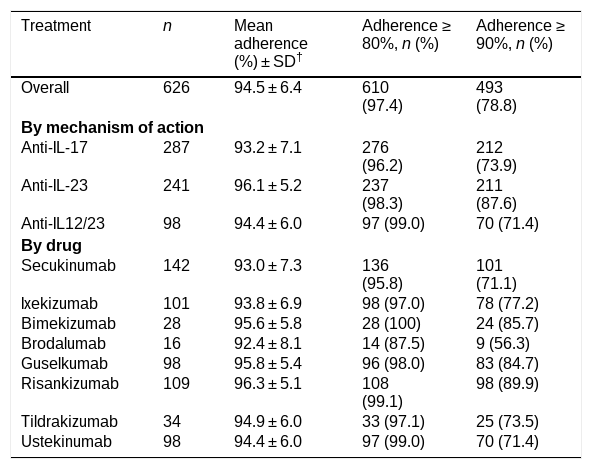
Mean overall adherence was 94.5 ± 6.4%, and median adherence was 96.2% (interquartile range [IQR]: 92.3–100%). Adherence ≥80% was observed in 97.4% of treatment courses, and adherence ≥90% in 78.8%. High adherence was observed across all therapeutic groups, with slightly higher adherence among patients treated with IL-23 inhibitors (Table 2).
Overall adherence to biologic treatment by mechanism of action and by drug (percentages are calculated based on the total number of treatment courses in each group).
| Treatment | n | Mean adherence (%) ± SD† | Adherence ≥80%, n (%) | Adherence ≥90%, n (%) |
|---|---|---|---|---|
| Overall | 626 | 94.5 ± 6.4 | 610 (97.4) | 493 (78.8) |
| By mechanism of action | ||||
| Anti-IL-17 | 287 | 93.2 ± 7.1 | 276 (96.2) | 212 (73.9) |
| Anti-IL-23 | 241 | 96.1 ± 5.2 | 237 (98.3) | 211 (87.6) |
| Anti-IL12/23 | 98 | 94.4 ± 6.0 | 97 (99.0) | 70 (71.4) |
| By drug | ||||
| Secukinumab | 142 | 93.0 ± 7.3 | 136 (95.8) | 101 (71.1) |
| Ixekizumab | 101 | 93.8 ± 6.9 | 98 (97.0) | 78 (77.2) |
| Bimekizumab | 28 | 95.6 ± 5.8 | 28 (100) | 24 (85.7) |
| Brodalumab | 16 | 92.4 ± 8.1 | 14 (87.5) | 9 (56.3) |
| Guselkumab | 98 | 95.8 ± 5.4 | 96 (98.0) | 83 (84.7) |
| Risankizumab | 109 | 96.3 ± 5.1 | 108 (99.1) | 98 (89.9) |
| Tildrakizumab | 34 | 94.9 ± 6.0 | 33 (97.1) | 25 (73.5) |
| Ustekinumab | 98 | 94.4 ± 6.0 | 97 (99.0) | 70 (71.4) |
When adherence was analyzed by individual biologic agent, consistently high adherence rates were observed across all treatments (Table 2). Among IL-17 inhibitors, mean adherence was comparable for secukinumab and ixekizumab, while slightly higher values were observed for bimekizumab. Brodalumab showed numerically lower adherence, although the number of treatment courses was limited.
Among IL-23 inhibitors, both guselkumab and risankizumab demonstrated high adherence rates, with risankizumab showing the highest proportion of treatment courses achieving excellent adherence (MPR ≥90%). Adherence with tildrakizumab was also high, although based on a smaller sample size.
Ustekinumab showed high overall adherence, comparable to that observed with IL-17 inhibitors.
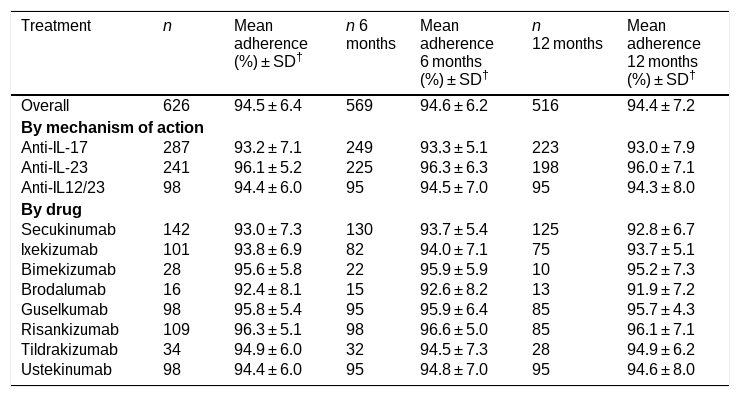
Adherence according to follow-up duration is shown in Table 3. Mean adherence remained stable among treatment courses with at least 6 months (n = 569) and at least 12 months (n = 516) of follow-up compared with the overall cohort. Similar results were observed across mechanisms of action and individual biologic agents.
Adherence according to minimum follow-up duration (6 and 12 months) (percentages are calculated based on the total number of treatment courses in each group).
| Treatment | n | Mean adherence (%) ± SD† | n 6 months | Mean adherence 6 months (%) ± SD† | n 12 months | Mean adherence 12 months (%) ± SD† |
|---|---|---|---|---|---|---|
| Overall | 626 | 94.5 ± 6.4 | 569 | 94.6 ± 6.2 | 516 | 94.4 ± 7.2 |
| By mechanism of action | ||||||
| Anti-IL-17 | 287 | 93.2 ± 7.1 | 249 | 93.3 ± 5.1 | 223 | 93.0 ± 7.9 |
| Anti-IL-23 | 241 | 96.1 ± 5.2 | 225 | 96.3 ± 6.3 | 198 | 96.0 ± 7.1 |
| Anti-IL12/23 | 98 | 94.4 ± 6.0 | 95 | 94.5 ± 7.0 | 95 | 94.3 ± 8.0 |
| By drug | ||||||
| Secukinumab | 142 | 93.0 ± 7.3 | 130 | 93.7 ± 5.4 | 125 | 92.8 ± 6.7 |
| Ixekizumab | 101 | 93.8 ± 6.9 | 82 | 94.0 ± 7.1 | 75 | 93.7 ± 5.1 |
| Bimekizumab | 28 | 95.6 ± 5.8 | 22 | 95.9 ± 5.9 | 10 | 95.2 ± 7.3 |
| Brodalumab | 16 | 92.4 ± 8.1 | 15 | 92.6 ± 8.2 | 13 | 91.9 ± 7.2 |
| Guselkumab | 98 | 95.8 ± 5.4 | 95 | 95.9 ± 6.4 | 85 | 95.7 ± 4.3 |
| Risankizumab | 109 | 96.3 ± 5.1 | 98 | 96.6 ± 5.0 | 85 | 96.1 ± 7.1 |
| Tildrakizumab | 34 | 94.9 ± 6.0 | 32 | 94.5 ± 7.3 | 28 | 94.9 ± 6.2 |
| Ustekinumab | 98 | 94.4 ± 6.0 | 95 | 94.8 ± 7.0 | 95 | 94.6 ± 8.0 |
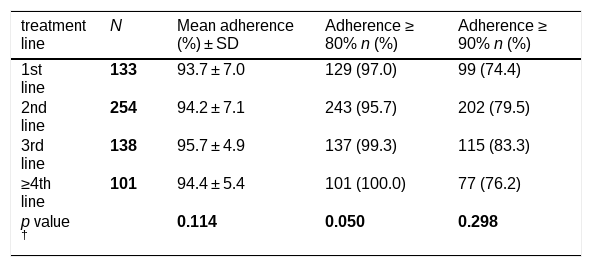
Adherence according to treatment line is shown in Table 4. Mean adherence remained consistently high across all treatment lines, ranging from 93.7% in first-line therapy to 95.7% in third-line therapy, with no statistically significant differences (p = 0.114). Similarly, the proportion of treatment courses achieving excellent adherence (MPR ≥ 90%) did not differ significantly between treatment lines (p = 0.298). Although the proportion of treatment courses with adequate adherence (MPR ≥ 80%) showed borderline statistical significance (p = 0.050), the absolute differences between groups were small.
Adherence according to treatment line.
| treatment line | N | Mean adherence (%) ± SD | Adherence ≥80% n (%) | Adherence ≥90% n (%) |
|---|---|---|---|---|
| 1st line | 133 | 93.7 ± 7.0 | 129 (97.0) | 99 (74.4) |
| 2nd line | 254 | 94.2 ± 7.1 | 243 (95.7) | 202 (79.5) |
| 3rd line | 138 | 95.7 ± 4.9 | 137 (99.3) | 115 (83.3) |
| ≥4th line | 101 | 94.4 ± 5.4 | 101 (100.0) | 77 (76.2) |
| p value† | 0.114 | 0.050 | 0.298 |
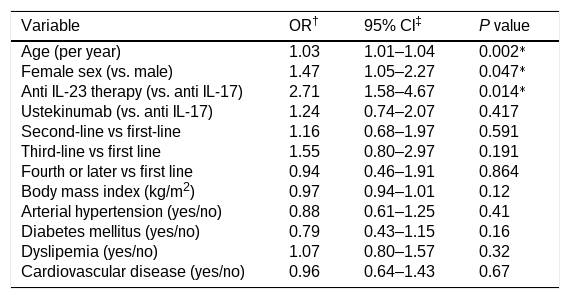
In multivariable analysis, older age, female sex and treatment with IL-23 inhibitors were independently associated with a higher probability of excellent adherence. No significant associations were observed between adherence and comorbidities (Table 5).
Factors associated with excellent adherence (MPR ≥ 90%): multivariable logistic regression analysis adjusted for demographic, clinical, and treatment-related variables.
| Variable | OR† | 95% CI‡ | P value |
|---|---|---|---|
| Age (per year) | 1.03 | 1.01–1.04 | 0.002⁎ |
| Female sex (vs. male) | 1.47 | 1.05–2.27 | 0.047⁎ |
| Anti IL-23 therapy (vs. anti IL-17) | 2.71 | 1.58–4.67 | 0.014⁎ |
| Ustekinumab (vs. anti IL-17) | 1.24 | 0.74–2.07 | 0.417 |
| Second-line vs first-line | 1.16 | 0.68–1.97 | 0.591 |
| Third-line vs first line | 1.55 | 0.80–2.97 | 0.191 |
| Fourth or later vs first line | 0.94 | 0.46–1.91 | 0.864 |
| Body mass index (kg/m2) | 0.97 | 0.94–1.01 | 0.12 |
| Arterial hypertension (yes/no) | 0.88 | 0.61–1.25 | 0.41 |
| Diabetes mellitus (yes/no) | 0.79 | 0.43–1.15 | 0.16 |
| Dyslipemia (yes/no) | 1.07 | 0.80–1.57 | 0.32 |
| Cardiovascular disease (yes/no) | 0.96 | 0.64–1.43 | 0.67 |
This large multicenter real-world study including 423 patients and 626 biologic treatment courses provides robust pharmacoepidemiologic evidence of very high adherence to IL-17, IL-23 and IL-12/23 inhibitors in patients with moderate-to-severe psoriasis treated for at least 4 months in hospital pharmacy settings. To our knowledge, this is one of the largest real-world studies evaluating adherence across multiple biologic therapies for psoriasis in routine clinical practice. These findings are particularly relevant from a pharmacotherapy perspective because biologic therapies for psoriasis are high-cost treatments whose effectiveness in routine practice strongly depends on sustained adherence.
These results are broadly consistent with previous real-world studies evaluating adherence to biologic therapies in psoriasis, although adherence in our cohort was at the upper end of the values reported in routine clinical practice. Santoleri et al., in a multicenter Italian real-world study, reported a mean PDC of 68% and found that 47.6% of patients achieved a PDC ≥ 0.80, highlighting substantial variability between biologic agents.10 Similarly, Piragine et al., in a systematic review and meta-analysis including 55 observational studies and 161,748 patients, reported a pooled proportion of adherent patients of 61% (95% CI 48–73%), with considerable heterogeneity according to the biologic agent and adherence assessment method.11 Likewise, Murage et al., in a real-world cohort of 2130 patients with psoriasis treated with biologics, reported a mean MPR of 73.9% and found that only 52.2% of patients achieved an MPR > 80%.12 In contrast, our cohort showed a mean adherence of 94.5%, substantially higher than previously reported real-world estimates. This difference may be explained by the organization of biologic dispensing in the Spanish hospital pharmacy setting, where patients undergo regular pharmaceutical follow-up and medication is dispensed through specialist outpatient hospital pharmacy services, facilitating close monitoring and reinforcing treatment adherence.
Older age was independently associated with better adherence, a finding previously reported in psoriasis and other chronic inflammatory diseases. In a large U.S. population-based study, Takeshita et al. observed that patients older than 50 years had adherence rates approximately 10% higher than younger patients when measured using dispensing-based metrics.1 Similar results have been described in European cohorts, where older age has been associated with higher adherence and persistence to biologic therapies.13 One possible explanation is that older patients have historically been exposed to less effective therapeutic options, including conventional systemic treatments, which may lead to a greater appreciation of the benefits of current biologic therapies and consequently higher adherence. In contrast, younger patients may have initiated treatment in a more recent therapeutic era characterized by highly effective biologic agents, potentially resulting in different expectations regarding treatment outcomes and adherence behavior.
In addition, adherence remained consistently high across all treatment lines, with no statistically significant differences in mean adherence or the proportion of treatment courses achieving excellent adherence. These findings suggest that treatment line does not appear to substantially influence adherence in routine clinical practice, as high adherence was maintained irrespective of the previous biologic exposure.
Female sex was also associated with excellent adherence. Observational studies in chronic diseases have reported higher adherence among women, with relative differences ranging from 5% to 15% depending on the adherence measure used, possibly reflecting greater engagement with treatment and more frequent interaction with healthcare services.3,4 However, evidence in psoriasis remains heterogeneous, and some studies have not observed sex-related differences.14
Treatment with IL-23 inhibitors was independently associated with higher adherence in the multivariable analysis. This observation is consistent with previous studies reporting high drug survival and low discontinuation rates for this therapeutic class.13,15,16 IL-23 inhibitors have demonstrated sustained efficacy and a favorable safety profile in clinical trials and long-term extension studies, with discontinuation due to adverse events reported in less than 5% of patients.14,17,18 In addition, these agents are administered at longer dosing intervals compared with several other biologic therapies used in psoriasis, which may reduce treatment burden and facilitate adherence in routine clinical practice. The higher adherence observed with IL-23 inhibitors is likely to be multifactorial and cannot be explained solely by dosing interval. Although risankizumab and tildrakizumab share a 12-week maintenance schedule, ustekinumab, which also has a 12-week maintenance interval, did not show the same association. Likewise, guselkumab, administered every 8 weeks, also demonstrated high adherence. Therefore, factors beyond dosing frequency, including treatment effectiveness, tolerability and patient satisfaction, may also contribute to the favorable adherence observed with IL-23 inhibitors.
Analysis by individual biologic agent showed high adherence across all drugs included in the study, with some variability within therapeutic classes. Among IL-23 inhibitors, risankizumab and guselkumab were associated with particularly high adherence, which may be related to their favorable safety profile, high efficacy, and longer dosing intervals, as previously reported in clinical trials and real-world studies.14,15,17,18 Within the IL-17 inhibitor class, adherence was generally high and comparable between secukinumab and ixekizumab, while lower adherence observed with brodalumab should be interpreted cautiously given the small number of treatment courses and its distinct mechanism of action and safety considerations. Overall, these findings suggest that both class-related factors and individual drug characteristics, such as dosing frequency and tolerability, may influence adherence in real-world clinical practice.
Importantly, adherence constitutes a key prerequisite for the appropriate interpretation of treatment persistence. Persistence analyses assume that patients remain exposed to the medication during follow-up; however, suboptimal adherence may lead to misclassification of treatment exposure and potentially biased estimates of treatment persistence. Therefore, systematic evaluation of adherence should be considered an essential step in studies assessing long-term treatment outcomes with biologic therapies.
Our study has several strengths that should be highlighted. First, it includes a large number of patients and treatment courses, providing robust real-world evidence on adherence to biologic therapies in psoriasis. Second, the study encompasses a broad range of biologic agents targeting different inflammatory pathways, including IL-17, IL-23 and IL-12/23 inhibitors, allowing comparisons across therapeutic classes. Third, the long observation period and the multicenter design, including both a tertiary hospital and regional hospitals within the same public healthcare system, enhance the external validity of the findings and reflect routine clinical practice.
This study also has limitations. Its retrospective design may introduce inherent biases related to observational data. Furthermore, only treatment courses lasting at least 4 months were included. Consequently, patients who discontinued treatment during the induction phase because of adverse events, lack of effectiveness or other reasons were excluded. This selection criterion may have resulted in an overestimation of adherence by restricting the analysis to patients who achieved initial treatment persistence. In addition, adherence was assessed using a single indirect measure based on dispensing records, which does not guarantee actual drug administration. Although dispensing-based measures such as the medication possession ratio are widely used in pharmacoepidemiologic studies, they may overestimate adherence because medication collection does not necessarily ensure drug administration. Future studies could complement these metrics with additional adherence assessment tools, such as validated questionnaires or patient-reported measures, to provide a more comprehensive evaluation of adherence behavior. Moreover, the retrospective design and the variability of routine clinical practice resulted in heterogeneous follow-up durations and non-standardized timing of clinical assessments across treatment courses. Consequently, comparisons of clinical response over time should be interpreted with caution. Future prospective studies with standardized follow-up assessments will be needed to evaluate the relationship between adherence and clinical outcomes more robustly. Nevertheless, the use of dispensing data allows the evaluation of adherence in large real-world populations over long follow-up periods, which represents a key strength of pharmacoepidemiologic studies.
To conclude, in this large multicenter real-world study including a broad range of biologic therapies, adherence to treatment targeting IL-17, IL-23 and IL-12/23 in patients with moderate-to-severe psoriasis for at least 4 months was very high. These findings provide robust real-world evidence on adherence patterns in routine clinical practice. Systematic assessment of adherence using dispensing-based metrics such as the MPR is essential for the appropriate interpretation of treatment outcomes and should be considered a prerequisite for reliable persistence analyses and for optimizing the clinical and economic value of biologic therapies in routine practice.
Contribution to the scientific literatureThis multicenter real-world study provides robust evidence of very high adherence to biologic therapies targeting interleukin 17, interleukin 23 and interleukin 12/23 in patients for at least 4 months with moderate-to-severe psoriasis and identifies factors associated with optimal adherence. The findings highlight the importance of systematically assessing adherence when interpreting treatment outcomes and conducting persistence analyses, supporting the role of hospital pharmacy services in the long-term management of biologic therapies.
Ethical responsibilities statementThe study was conducted in accordance with Good Clinical Practice guidelines and Organic Law 3/2018 on the Protection of Personal Data and Guarantee of Digital Rights.
Authorship and copyright transfer statementMaría Calvo Arbeloa, Joaquín Borrás Blasco and Ramón San Miguel Elcano designed the study. María Calvo Arbeloa and Amaya Arrondo Velasco collected the data. María Calvo Arbeloa analysed the results and drafted the first version of the manuscript, which she sent to the other authors. They reviewed it and provided comments and contributions. Finally, all authors approved the final version.
Declaration on the use of generative artificial intelligenceThe authors did not use generative artificial intelligence tools or artificial intelligence assisted technologies during the preparation, writing, analysis or editing of this manuscript.
Dissemination of resultsThis article has not been presented at any congress or scientific meeting.
The manuscript is not currently under review by any other scientific journal.
CRediT authorship contribution statementMaría Calvo-Arbeloa: Writing – review & editing, Writing – original draft, Software, Methodology, Investigation, Formal analysis, Data curation, Conceptualization. Ramón San Miguel-Elcano: Writing – review & editing, Validation, Supervision, Methodology, Conceptualization. Amaya Arrondo-Velasco: Writing – review & editing, Visualization, Validation, Investigation, Data curation. Maite Sarobe-Carricas: Visualization, Validation, Supervision. Joaquín Borrás-Blasco: Writing – review & editing, Visualization, Validation, Supervision, Methodology, Investigation, Conceptualization.
FundingNo funding.
No conflicts of interest.