

The design and implementation of antimicrobial stewardship programs for patients admitted to intensive care units must consider the specific characteristics of this population, including infection severity, organ dysfunction, and pharmacokinetic/pharmacodynamic alterations.
The creation of a multidisciplinary team and the establishment of clear, targeted objectives are essential to improve treatment appropriateness, reduce the emergence of antimicrobial resistance, and ensure the sustainability of healthcare system.
Pharmaceutical care contributes to the optimisation of antimicrobial use through antimicrobial therapy review, dose individualisation based on pharmacokinetic/pharmacodynamic parameters, and treatment monitoring, while also facilitating the development of systems for monitoring clinical outcomes, microbiology, and antimicrobial consumption.
El diseño e implementación de Programas de Optimización de Antimicrobianos en pacientes ingresados en las unidades de cuidados intensivos debe considerar las especificidades de esta población, incluida la gravedad de la infección, las disfunciones orgánicas y las alteraciones en la farmacocinética y la farmacodinamia.
La creación de un equipo multidisciplinar y el desarrollo de objetivos específicos son esenciales para mejorar la adecuación de los tratamientos, reducir la aparición de resistencias a los antimicrobianos y favorecer la sostenibilidad del sistema sanitario.
La atención farmacéutica contribuye a la optimización del uso de antimicrobianos mediante la revisión de la terapéutica antimicrobiana, la individualización posológica basada en parámetros de farmacocinética/farmacodinamia y la monitorización del tratamiento, facilitando además el desarrollo de sistemas de monitorización clínica, microbiológica y de consumo.
Antimicrobial stewardship programmes (ASPs) implement coordinated interventions to improve and monitor the appropriate use of these medicines to ensure best practices for prescription in terms of dose, duration and route of administration.1
In the context of intensive care units (ICUs), the primary objective of ASPs is to promote the appropriate use of antimicrobials to improve clinical outcomes and the prognosis of patients with infections. In addition, ASPs aim to minimise antimicrobial-related adverse effects (AEs), including resistance selection and incidences of healthcare-associated infections, as well as to ensure the use of cost-effective treatments.1,2
RationaleAntimicrobial resistance (AMR) poses a growing threat to healthcare worldwide. The sustained increase in multidrug-resistant (MDR) microorganisms has reduced the availability of treatment options and, in the most extreme cases, requires combination treatments with a higher risk of toxicity.3 The 2024 report by the European Centre for Disease Prevention and Control (ECDC) illustrates the scale of the problem: resistance in Escherichia coli to fluoroquinolones and third-generation cephalosporins was 22.5% and 16.0%, respectively4; Klebsiella pneumoniae and Acinetobacter baumannii have resistance rates exceeding 50% against carbapenems.5
In ICUs, the incidence of MDR microorganisms is considerably higher than in other hospital wards or the community setting, reaching up to 42.5% of isolates in some series.6 Among ICU patients with multidrug-resistant bacterial colonisation or infection on admission, the 2024 ENVIN-HELICS registry identified ESBL-producing Enterobacteriaceae (3.49%) and methicillin-resistant Staphylococcus aureus (MRSA) (1.26%) as the predominant pathogens.7 Furthermore, most of the factors predisposing to the acquisition of these infections are present in this population: prolonged hospital stays, frequent use of invasive procedures and devices (mechanical ventilation, central venous catheters, tracheostomies or nasogastric tubes), immune system disorders and high consumption of antimicrobials.2,6,8,9 In this regard, over 70% of these patients receive at least one antimicrobial agent during their stay10, with an average of 2.24 per treated patient. Broad-spectrum antimicrobials are frequently used in severe infections (with 74.1% of treatments being empirical). Between 43% and 54% of patients admitted to the ICU do so with a suspected or confirmed infection, and the rate of healthcare-associated infections is 5.33%.7,10
In critically ill patients, pathophysiological changes and organ dysfunction can significantly alter the pharmacokinetics and pharmacodynamics (PK/PD) of antimicrobials.11,12 This occurs, for example, in septic shock, where achieving appropriate PK/PD targets is particularly challenging. Hydrophilic antibiotics eliminated via the kidneys, such as aminoglycosides, beta-lactams, glycopeptides or lipopeptides, may be affected by changes in volume of distribution or elimination, which requires the use of loading doses and adjustments to the maintenance dose regimen. Conversely, lipophilic antibiotics metabolised by the liver — such as fluoroquinolones, tigecycline, tetracyclines, lincosamides, macrolides or metronidazole — accumulate more frequently in intracellular tissue, and their exposure may be altered by changes in liver function.13,14 Furthermore, critically ill patients may undergo renal replacement therapy (RRT) or extracorporeal membrane oxygenation (ECMO), which can substantially alter the pharmacokinetics of numerous antimicrobials, requiring specific adjustments to their dosing to optimise therapeutic efficacy and minimise toxicity.15
Physiological stress is characteristic of critically ill patients and includes the systemic inflammatory response, hypoperfusion, metabolic disturbances and reduced intestinal motility, all of which contribute significantly to the disruption of the gut microbiome.16,17 Dysbiosis is common in ICU patients due to exposure to broad-spectrum antimicrobials, nutrient deprivation and the use of opioids, vasoactive agents and proton pump inhibitors.18 These alterations increase the risk of colonisation and infection by MDR microorganisms. Fungal infections are also significant, particularly invasive candidiasis, for which early treatment improves survival but risks overuse of antifungals.19
In view of the above, ASPs exist to ensure the rational, safe and efficient use of antimicrobials in the ICU. They rely on scientific evaluation to select the most appropriate antimicrobial for each patient, taking into account criteria of effectiveness, safety and cost-effectiveness.
They analyse antimicrobial use and its impact on clinical outcomes and antimicrobial resistance (AMR). The aim is to improve clinical outcomes, reduce treatment-related adverse events, preserve the hospital ecosystem and ensure cost-effective therapy.1 The involvement of the clinical pharmacist in ICU ASPs is essential in this context to integrate complex PK/PD alterations, the specific characteristics of life-support techniques and optimise antimicrobial use.
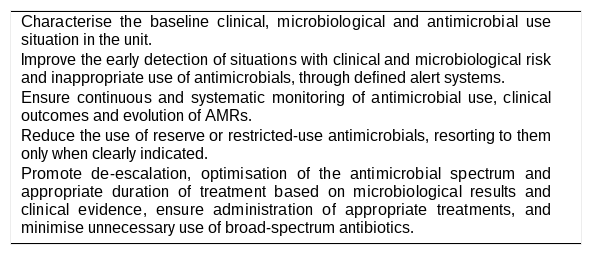
Table 1 details the main objectives and actions of ICU-specific ASPs.
Specific objectives of ASPs in intensive care units.
| Characterise the baseline clinical, microbiological and antimicrobial use situation in the unit. |
| Improve the early detection of situations with clinical and microbiological risk and inappropriate use of antimicrobials, through defined alert systems. |
| Ensure continuous and systematic monitoring of antimicrobial use, clinical outcomes and evolution of AMRs. |
| Reduce the use of reserve or restricted-use antimicrobials, resorting to them only when clearly indicated. |
| Promote de-escalation, optimisation of the antimicrobial spectrum and appropriate duration of treatment based on microbiological results and clinical evidence, ensure administration of appropriate treatments, and minimise unnecessary use of broad-spectrum antibiotics. |
AMR: antimicrobial resistance.
In 2012, the Spanish Society of Infectious Diseases and Clinical Microbiology (SEIMC), the Spanish Society of Hospital Pharmacy (SEFH) and the Spanish Society of Preventive Medicine, Public Health and Healthcare Management (SEMPSPGS) published a consensus document containing recommendations for the implementation of ASPs in acute care hospitals in Spain.1 Subsequently, in 2022, these societies, together with the Spanish Society of Intensive, Critical Care and Coronary Care Medicine (SEMICYUC) and the Spanish Society of Paediatric Infectious Diseases (SEIP), updated these recommendations through a new consensus document incorporating specific ASP measures for particular populations, including a section dedicated to patients admitted to the ICU.20
To implement ASPs in ICUs, it is first necessary to establish a multidisciplinary team of professionals dedicated part-time or full-time to reviewing antimicrobial therapy. Tipically, the team is led by an intensive care physician at the ICU, working in close collaboration with a specialist in infectious diseases, a pharmacist with antimicrobial expertise, a microbiologist, and specialists in preventive medicine to coordinate outbreak control measures and other preventive actions.1,20 The ICU's ASP must be functionally integrated with the hospital-wide ASP and the Infectious Diseases Committee to ensure strategic consistency and continuity of care.
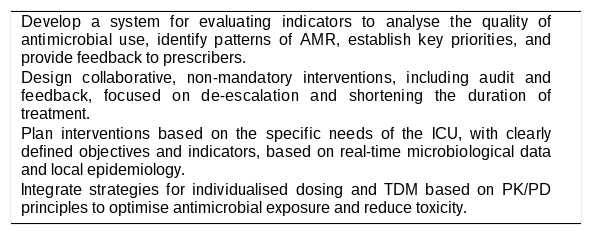
The design and implementation of ASP measures for critically ill patients should prioritise four specific points (Table 2).
Design areas of ASP actions.
| Develop a system for evaluating indicators to analyse the quality of antimicrobial use, identify patterns of AMR, establish key priorities, and provide feedback to prescribers. |
| Design collaborative, non-mandatory interventions, including audit and feedback, focused on de-escalation and shortening the duration of treatment. |
| Plan interventions based on the specific needs of the ICU, with clearly defined objectives and indicators, based on real-time microbiological data and local epidemiology. |
| Integrate strategies for individualised dosing and TDM based on PK/PD principles to optimise antimicrobial exposure and reduce toxicity. |
PK/PD, pharmacokinetics/pharmacodynamics; AMR, antimicrobial resistance; TDM, therapeutic drug monitoring; ICU, intensive care unit.
Table 3 contains implementation recommendations for specific actions based on these areas.
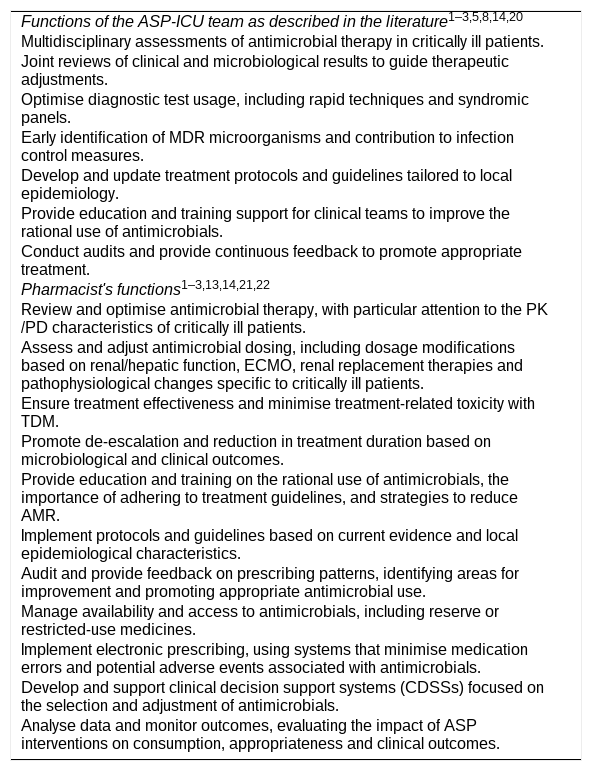
Team roles in ASPs in ICUs as described in the literature, and the specific role of the pharmacist.
| Functions of the ASP-ICU team as described in the literature1–3,5,8,14,20 |
| Multidisciplinary assessments of antimicrobial therapy in critically ill patients. |
| Joint reviews of clinical and microbiological results to guide therapeutic adjustments. |
| Optimise diagnostic test usage, including rapid techniques and syndromic panels. |
| Early identification of MDR microorganisms and contribution to infection control measures. |
| Develop and update treatment protocols and guidelines tailored to local epidemiology. |
| Provide education and training support for clinical teams to improve the rational use of antimicrobials. |
| Conduct audits and provide continuous feedback to promote appropriate treatment. |
| Pharmacist's functions1–3,13,14,21,22 |
| Review and optimise antimicrobial therapy, with particular attention to the PK/PD characteristics of critically ill patients. |
| Assess and adjust antimicrobial dosing, including dosage modifications based on renal/hepatic function, ECMO, renal replacement therapies and pathophysiological changes specific to critically ill patients. |
| Ensure treatment effectiveness and minimise treatment-related toxicity with TDM. |
| Promote de-escalation and reduction in treatment duration based on microbiological and clinical outcomes. |
| Provide education and training on the rational use of antimicrobials, the importance of adhering to treatment guidelines, and strategies to reduce AMR. |
| Implement protocols and guidelines based on current evidence and local epidemiological characteristics. |
| Audit and provide feedback on prescribing patterns, identifying areas for improvement and promoting appropriate antimicrobial use. |
| Manage availability and access to antimicrobials, including reserve or restricted-use medicines. |
| Implement electronic prescribing, using systems that minimise medication errors and potential adverse events associated with antimicrobials. |
| Develop and support clinical decision support systems (CDSSs) focused on the selection and adjustment of antimicrobials. |
| Analyse data and monitor outcomes, evaluating the impact of ASP interventions on consumption, appropriateness and clinical outcomes. |
AEs, adverse events; ECMO, extracorporeal membrane oxygenation; MDR, multidrug-resistant; PK/PD, pharmacokinetics/pharmacodynamics; ASP, antimicrobial stewardship programme; AMR, antimicrobial resistance; TDM, therapeutic drug monitoring; ICU, intensive care unit.
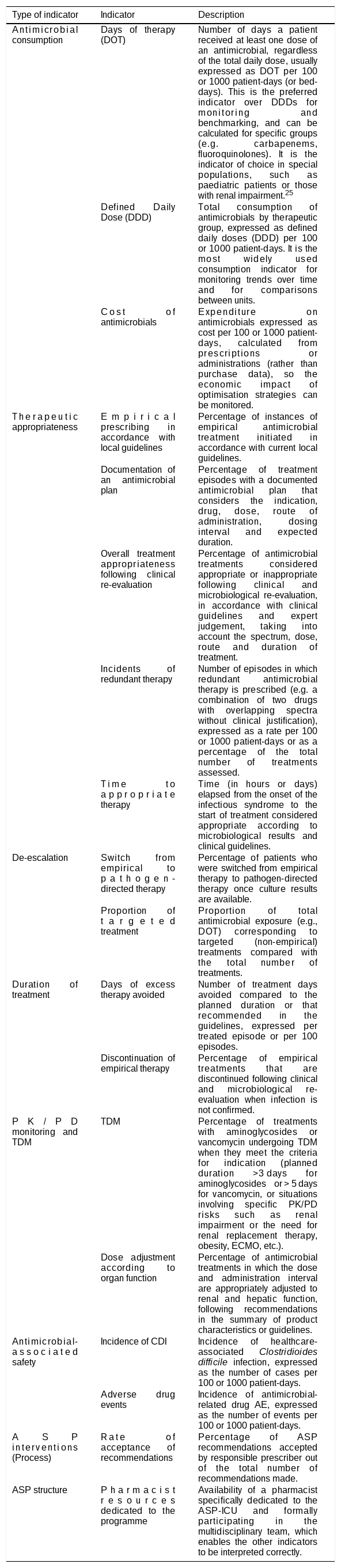
Table 4 shows various indicators described in the literature that empower the pharmacist to evaluate the structure, processes, and outcomes of these strategies to provide general and actionable measures for ASPs in ICUs.23,24 This is a set of indicators to monitor appropriateness of antimicrobial use in critically ill patients admitted to the ICU, which must be complemented by overall clinical indicators assessed by the multidisciplinary team.
Recommended indicators for pharmacists monitoring the ICU ASP.
| Type of indicator | Indicator | Description |
|---|---|---|
| Antimicrobial consumption | Days of therapy (DOT) | Number of days a patient received at least one dose of an antimicrobial, regardless of the total daily dose, usually expressed as DOT per 100 or 1000 patient-days (or bed-days). This is the preferred indicator over DDDs for monitoring and benchmarking, and can be calculated for specific groups (e.g. carbapenems, fluoroquinolones). It is the indicator of choice in special populations, such as paediatric patients or those with renal impairment.25 |
| Defined Daily Dose (DDD) | Total consumption of antimicrobials by therapeutic group, expressed as defined daily doses (DDD) per 100 or 1000 patient-days. It is the most widely used consumption indicator for monitoring trends over time and for comparisons between units. | |
| Cost of antimicrobials | Expenditure on antimicrobials expressed as cost per 100 or 1000 patient-days, calculated from prescriptions or administrations (rather than purchase data), so the economic impact of optimisation strategies can be monitored. | |
| Therapeutic appropriateness | Empirical prescribing in accordance with local guidelines | Percentage of instances of empirical antimicrobial treatment initiated in accordance with current local guidelines. |
| Documentation of an antimicrobial plan | Percentage of treatment episodes with a documented antimicrobial plan that considers the indication, drug, dose, route of administration, dosing interval and expected duration. | |
| Overall treatment appropriateness following clinical re-evaluation | Percentage of antimicrobial treatments considered appropriate or inappropriate following clinical and microbiological re-evaluation, in accordance with clinical guidelines and expert judgement, taking into account the spectrum, dose, route and duration of treatment. | |
| Incidents of redundant therapy | Number of episodes in which redundant antimicrobial therapy is prescribed (e.g. a combination of two drugs with overlapping spectra without clinical justification), expressed as a rate per 100 or 1000 patient-days or as a percentage of the total number of treatments assessed. | |
| Time to appropriate therapy | Time (in hours or days) elapsed from the onset of the infectious syndrome to the start of treatment considered appropriate according to microbiological results and clinical guidelines. | |
| De-escalation | Switch from empirical to pathogen-directed therapy | Percentage of patients who were switched from empirical therapy to pathogen-directed therapy once culture results are available. |
| Proportion of targeted treatment | Proportion of total antimicrobial exposure (e.g., DOT) corresponding to targeted (non-empirical) treatments compared with the total number of treatments. | |
| Duration of treatment | Days of excess therapy avoided | Number of treatment days avoided compared to the planned duration or that recommended in the guidelines, expressed per treated episode or per 100 episodes. |
| Discontinuation of empirical therapy | Percentage of empirical treatments that are discontinued following clinical and microbiological re-evaluation when infection is not confirmed. | |
| PK/PD monitoring and TDM | TDM | Percentage of treatments with aminoglycosides or vancomycin undergoing TDM when they meet the criteria for indication (planned duration >3 days for aminoglycosides or > 5 days for vancomycin, or situations involving specific PK/PD risks such as renal impairment or the need for renal replacement therapy, obesity, ECMO, etc.). |
| Dose adjustment according to organ function | Percentage of antimicrobial treatments in which the dose and administration interval are appropriately adjusted to renal and hepatic function, following recommendations in the summary of product characteristics or guidelines. | |
| Antimicrobial-associated safety | Incidence of CDI | Incidence of healthcare-associated Clostridioides difficile infection, expressed as the number of cases per 100 or 1000 patient-days. |
| Adverse drug events | Incidence of antimicrobial-related drug AE, expressed as the number of events per 100 or 1000 patient-days. | |
| ASP interventions (Process) | Rate of acceptance of recommendations | Percentage of ASP recommendations accepted by responsible prescriber out of the total number of recommendations made. |
| ASP structure | Pharmacist resources dedicated to the programme | Availability of a pharmacist specifically dedicated to the ASP-ICU and formally participating in the multidisciplinary team, which enables the other indicators to be interpreted correctly. |
Source: Various authors23,24,26–32
AEs, adverse events; ECMO, extracorporeal membrane oxygenation; MDR, multidrug-resistant; PK/PD, pharmacokinetics/pharmacodynamics; ASP, antimicrobial stewardship programme; AMR, antimicrobial resistance; TDM, therapeutic drug monitoring; ICU, intensive care unit.
The implementation of ASPs in ICUs must be tailored to the specific characteristics of critically ill patients and to the specific strategies required to optimise the use of antimicrobials and minimise AMR, with the participation of pharmacists. The appropriate administration of these treatments in ICUs helps to reduce infections caused by MDR microorganisms, improve clinical outcomes, and lower healthcare costs within a framework of interdisciplinary collaboration. In this context, the pharmacist has a critical role in ensuring therapeutic appropriateness, PK/PD optimisation, pharmacotherapeutic monitoring and the development of tools that facilitate the safe and efficient monitoring of antimicrobial therapy. In addition to selecting and monitoring treatments, pharmacists are well positioned within ASP-ICU to guide measurement of quality outcomes, integrate data on antimicrobial use and clinical outcomes, and promote the implementation of clinical decision support systems that reinforce the ASP culture in ICUs.
Contribution to the scientific literatureThis manuscript summarises the role of the pharmacist in antimicrobial optimisation in intensive care. It provides objectives, functions and practical indicators for evaluating and implementing optimisation programmes in ICUs.
Statement on ethical responsibilitiesThis work does not involve research on human or animal subjects and therefore did not require approval from a research ethics committee.
The authors declare that they have taken into account the ethical principles of biomedical research and the recommendations of the International Committee of Medical Journal Editors (ICMJE).
FundingNone declared.
None declared.