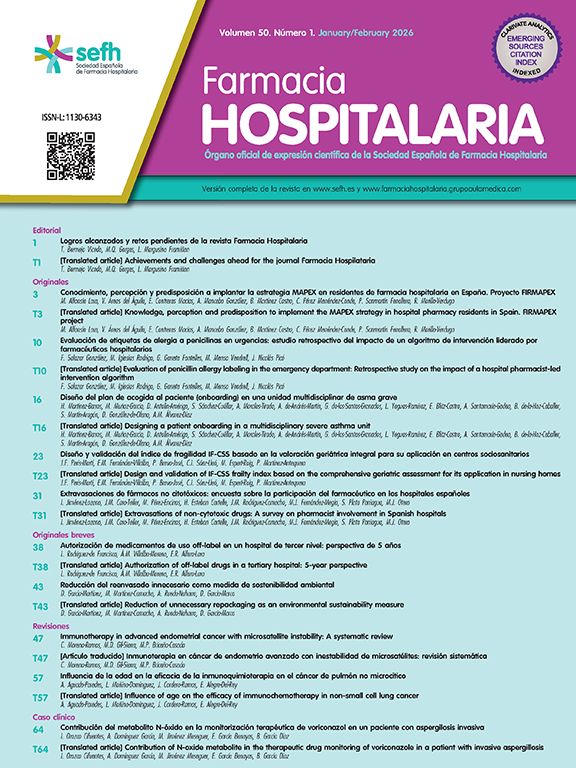
Several years ago, the Spanish Society of Hospital Pharmacy (SEFH) established as a strategic goal the inclusion of the journal Farmacia Hospitalaria (Farm Hosp) in the Journal Citation Reports of the Web of Science (WOS), since JCR metrics include the world's most prestigious scientific journals in all areas of knowledge. The other strategic goal included raising the journal's impact factor (IF) to equal or surpass that of other Pharmacology and Pharmacy journals. The IF reflects the quality and visibility of scientific publications, primarily measured by the number of citations an article receives from other authors in other journals. Achieving a high IF is a long and complex process that requires compliance with both quantitative and qualitative standards. With these main objectives in mind, the Chief Editors of Farm Hosp designed a Strategic Plan (SP) in 2017 focused on three strategic lines (SLs): scientific excellence, editorial management, and visibility. This four-year plan was the roadmap that allowed us to achieve the desired goal.
In the case of Farm Hosp, the process for entering JCR involved prior inclusion in the Emerging Sources Citation Index (ESCI) –part of the WOS Core Collection– in May 2019, when the journal was recognized to fulfill all 24 qualitative criteria. Subsequently, in June 2023, upon completion of a four-year period of ongoing evaluation where the journal demonstrated to comply with the required quantitative criteria, Farm Hosp entered the JCR journal list. A year later, Farm Hosp was included in the Q4 Journal Impact Factor (JIF). Currently, the IF of our journal is 1.3, advancing its position in the Quartile. This achievement, aligned with the SL of attaining scientific excellence, was the result of the following strategies: complying with evaluation platform criteria; accepting articles based on a high level of evidence; and publishing reviews, special articles, and monographs on current topics.
The strategies adopted to gain visibility were crucial for the success of our roadmap, where indexation in databases played a major role. Inclusion in ESCI has been one of the major milestones achieved, reflecting the relevance, uniqueness, and quality of the research papers published in our journal. Additionally, we are currently included in other prestigious databases such as Medline, Latindex, and DOAJ (Directory of Open Access Journals). Other approaches included sharing and publishing articles on different medical specialties, often in collaboration with other scientific societies with which the SEFH established alliances. Our ultimate purpose was to share knowledge and highlight the professional expertise of hospital pharmacists. We have published consensus documents with the Spanish Society of Urology; the Spanish Society of Ophthalmology; the Spanish Society of Medical Oncology; and the Spanish Society of Oncology Nursing; as well as other types of articles with the Spanish Society of Intensive Care Medicine and Coronary Care Units and the Spanish Association of Pediatrics.
Other visibility-oriented strategies involved building relationships with professionals from other pharmaceutical fields and countries. Since June 2022, we have been members of the International Collaboration of Pharmacy Journal Editors (ICPJE), which currently includes eleven open-access journals. The objective of ICPJE is to promote the quality and visibility of research publications on practical, clinical, and social pharmacy. At the international level, the SEFH Board jointly prepared the document “Proposals for lines of work for the journal Farmacia Hospitalaria with the American Society of Health-System Pharmacists (ASHP)” for analysis by both societies.
To increase the reach of our articles and promote citations from other researchers, we adopted digital marketing strategies that enhance our visibility, growth, and positioning on social media and online platforms. To improve our IF, we have leveraged social media as an essential communication tool. Over the past two years, our activity on X, Facebook and LinkedIn have shown substantial progress, marked by qualitative improvements in audience interaction and post consolidation. These efforts have notably expanded our reach and number of followers, ultimately contributing to the increase in our authors' H-index.
Improvements in our visibility are also evidenced by a 57% increase in article views and downloads via Science Direct recorded in June 2025, compared with the total for 2024.
Another strategy implemented over the last two years is the newsletter accompanying each issue, published in Spanish and English and distributed regularly via Mailchimp. The use of this tool enabled us to raise our visibility, as demonstrated by our open rate of 38–47%, which denotes great effectiveness and connection with readers. In the last year, our newsletter has also been distributed in English to the corresponding authors of articles of interest published in the American Journal of Health-System Pharmacy (AJHP) and in European Association of Hospital Pharmacists (EAHP) journals. In addition, for the past two years, we have posted two or three videos in relation to some articles, and a selection of published articles is distributed among the specialized and/or mainstream press.
Additionally, we have included an article search engine on the journal's website to assist our readers in searching for specific publications by area of interest.
Finally, among the visibility-oriented strategies, we highlight the regular publication of special issues on new advances in research and healthcare practice.
In terms of editorial management, our new publisher helped us improve our visibility and processing times. Furthermore, over the last year, we have updated our reviewer database, whose contribution is essential for ensuring timely and accurate peer review. Furthermore, our guidelines and editorial policy were updated where necessary. We also designed a checklist for editors and reviewers to ensure a standardized management of manuscripts. Furthermore, we continue to implement Search Engine Optimization criteria, an important tool for increasing the visibility of our manuscripts. Finally, we recently established a standard bibliography format for publication in Farm Hosp in tools such as Endnote, Mendeley, and Zotero, to assist authors in citing references correctly.
But we cannot stop here. We still have challenges to face in the immediate future. On the one hand, we must increase our IF to advance among the journals in our group and achieve a move to the top quartile. For such a purpose, it is necessary to ensure and enhance the quality of our manuscripts by enlisting high-profile SEFH authors and authors from other specialties involved in routine hospital pharmacy practice to support Farm Hosp. By publishing in our journal, authors will be cited in high-impact scientific publications, thereby helping us raise our IF and Q score and position our journal as a benchmark in Hospital Pharmacy. Another challenge is to expand our list of primarily national authors to include international authors, which will allow us to increase our IF. Other actions to be taken will include accelerating the editorial process and complying with the most demanding postulates related to the ethics of scientific publication. We must also strengthen our relationship with SEFH working groups and directors of education and research. Furthermore, the application of Artificial Intelligence (AI) to the peer review process to detect plagiarism and verify manuscript compliance with formatting standards will pose new challenges for the publishing world. In this scenario, developing appropriate implementation strategies will be crucial. AI models must be reliable and carefully evaluated to avoid introducing new biases. This technology could be useful for assigning reviewers and manuscripts, thereby reducing unnecessary reviews and optimizing the process.1
We are satisfied with the progress of the journal Farm Hosp. We have fulfilled our expectations.2
Farm Hosp achieved an IF of 1.3 in 2024 and is included in Q4. We believe the journal is moving in the right direction.
As in previous editions, we would like to deeply acknowledge the stakeholders who have contributed to these achievements. On the one hand, we would like to thank the members of the Editorial Committee for their effort and continuous work, not only in aspects related to the editorial process but also in proposing ideas and strategies to achieve our goals. To the hard and selfless work of the reviewers who, through the exhaustive peer review process and communication with editors, improved the quality of manuscripts and the editorial process. To our authors, who trusted our journal to publish their results in Farm Hospital. To the SEFH Board and other SEFH departments for their support, since they have provided the necessary resources over the years. And, of course, to our readers.
The SEFH's 2023–2027 Strategic Plan, focused on raising the visibility of our specialty, includes operational projects that will contribute to the growth and development of Hospital Pharmacy and support the scientific dissemination of Farm Hosp. For this reason, we once again request the selfless collaboration of all SEFH members, working groups, and other research groups recognized as such by the relevant agencies. With the collective support and commitment of our community, our journal will establish itself as a leader platform for publishing and enhancing the visibility of the innovation and research conducted in our country's Pharmacy Services.